Union Executive in India – Complete Notes for Kerala PSC
Learn about the Union Executive in India, including the President, Vice President, Prime Minister, Council of Ministers, and Attorney General. Complete exam-oriented notes for Kerala PSC and competitive exams.
SECTION 1: CONCEPT OF EXECUTIVE
- Definition of Executive: The executive is the branch of government responsible for the implementation of laws and policies framed by the legislature, and it looks after the day-to-day administration of the state.
- Types of Executive:
- Political Executive: Consists of the head of the state and ministers (e.g., President, Prime Minister, Ministers). They are temporary, elected by the people, and take major policy decisions.
- Permanent Executive: Consists of the bureaucracy or civil servants (e.g., All India Services, Central Services, State Services). They are permanent employees who assist the political executive in day-to-day administration and policy formulation.
- Nominal vs Real Executive:
- Nominal Executive (De Jure Executive): The President of India is the nominal head of the state. All executive actions are formally taken in their name.
- Real Executive (De Facto Executive): The Prime Minister and the Council of Ministers form the real executive authority and act as the head of the government.
- Parliamentary Executive: India follows a parliamentary system where the executive and legislature are interdependent. The legislature controls the executive, and the executive controls the legislature. As Dr. B.R. Ambedkar noted, the Constitution defines the powers of the Executive, Legislature, and Judiciary to ensure separation of powers and limit arbitrary actions, preventing total tyranny and oppression.
SECTION 2: UNION EXECUTIVE IN THE INDIAN CONSTITUTION
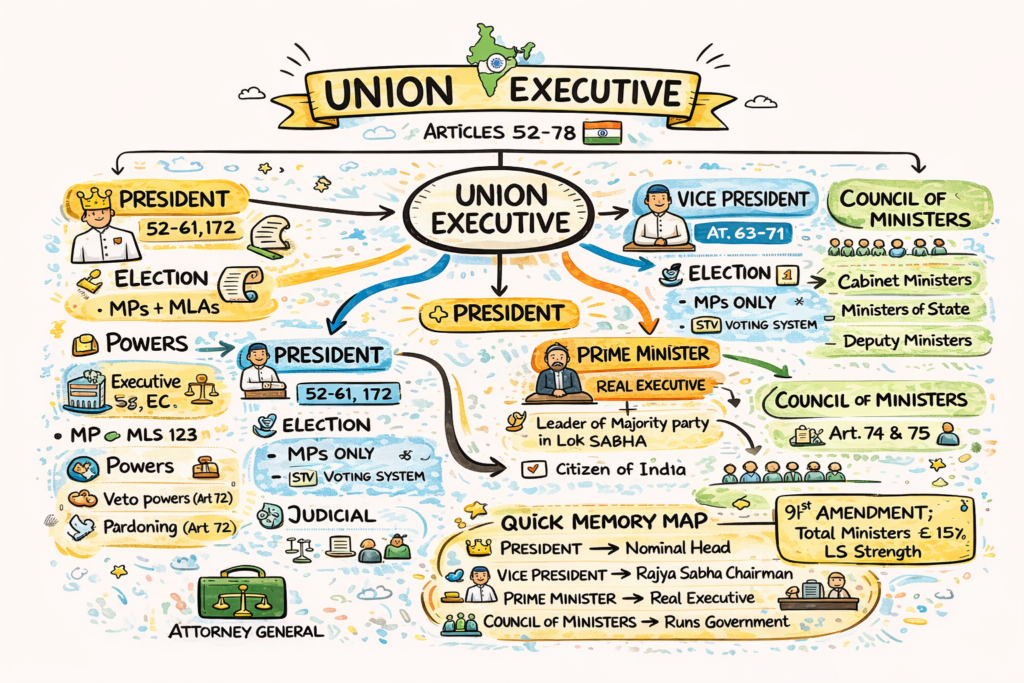
- Articles related to Union Executive: Part V, Chapter 1 of the Indian Constitution, covering Articles 52 to 78, deals with the Union Executive.
- Constitutional provisions: The Constitution establishes a system where the executive power of the Union is vested in the President (Article 53), but these powers are exercised through a Council of Ministers headed by the Prime Minister (Article 74).
- Structure of the Union Executive: The Union Executive consists of five components:
- The President
- The Vice President
- The Prime Minister
- The Council of Ministers
- The Attorney General of India.
SECTION 3: PRESIDENT OF INDIA
- Articles related to President:
- Article 52: There shall be a President of India.
- Article 53: Executive power of the Union shall be vested in the President.
- Position and status: The President is the head of the Indian state, the first citizen of India, the nominal/de jure executive authority, and the Supreme Commander of the Armed Forces.
- Qualifications (Article 58):
- Must be a citizen of India (acquired by birth, descent, registration, naturalization, or incorporation of territory as per Citizenship Act, 1955).
- Must have completed 35 years of age (unlike a Lok Sabha MP who requires 25 years).
- Must be qualified for election as a member of the Lok Sabha.
- Must not hold any office of profit under the Union/State government or any local/public authority. (Note: A sitting President, VP, Governor, or Minister does not hold an office of profit and is qualified to run).
- Election process:
- Indirectly elected (Article 54) using the system of proportional representation by means of the single transferable vote, with voting by secret ballot (Article 55). The concept is borrowed from Ireland.
- Nomination: Requires at least 50 electors as proposers and 50 as seconders.
- Security Deposit: ₹15,000 in the Reserve Bank of India. It is forfeited if the candidate fails to secure one-sixth (1/6th) of the valid votes polled.
- Conducting Authority: The Election Commission of India (Article 324). Returning officers rotate between the Rajya Sabha and Lok Sabha Secretary-Generals.
- Electoral college (Article 54):
- Consists of the elected members of both Houses of Parliament.
- Consists of the elected members of the Legislative Assemblies of the States (including NCT of Delhi and UT of Puducherry).
- Note: Nominated members of Parliament/Assemblies and members of State Legislative Councils do NOT participate.
- Value of vote calculation (Article 55): Uses the 1971 census for population figures (until the first census after 2026, as per the 84th Amendment Act, 2001).
- Value of vote of an MLA = (Population of State / Elected members of the state legislative assembly) × (1 / 1000).
- Value of vote of an MP = Total No. of votes assigned to all elected MLAs / Total No. of elected MPs (Lok Sabha + Rajya Sabha).
- Oath (Article 60):
- Administered by the Chief Justice of India (CJI), or in their absence, the senior-most Judge of the Supreme Court.
- The President swears in the name of God (or solemnly affirms) to faithfully execute the office, preserve, protect, and defend the Constitution and the law, and devote themselves to the service and well-being of the people of India.
- Term of office (Article 56 & 62):
- Five years from the date of entering office.
- All Presidents since Neelam Sanjiva Reddy take charge on 25th July.
- If a new election is delayed, the outgoing President continues until the successor is elected to prevent a vacancy.
- If a vacancy occurs (death, resignation, removal), an election must be held within 6 months. The Vice President acts as President. If there is no VP, the CJI acts as President. If there is no CJI, the senior-most SC judge acts as President. The new President serves a full 5-year term.
- Re-election (Article 57): A person who holds or has held the office is eligible for re-election. There is no term limit.
- Impeachment (Article 61):
- Ground: Only for “violation of the Constitution”.
- Participants: ALL members of Parliament (both elected and nominated) participate. State Legislative Assemblies do NOT participate.
- Procedure: Initiated in either house. Charges must be signed by 1/4th of the initiating house members. A 14-day prior notice is given (the Attorney General acts as the President’s lawyer). Passed by a 2/3rd majority of the total strength of that house. The other house then acts as a quasi-judicial body to investigate. If the second house also passes it by a 2/3rd total majority, the President is impeached.
- Note: No President has been impeached in India so far.
- Powers and functions:
- Executive powers: All executive actions are taken in their name. Can make rules for the convenient transaction of business. Appoints the PM, CoM, State Governors, CJI, SC/HC Judges, AG, CAG, CEC and Election Commissioners, UPSC Chairman/Members, and Ambassadors. Administers UTs directly. Declares and administers scheduled and tribal areas. Appoints commissions for SC/ST/OBCs and Inter-state councils.
- Legislative powers: Summons and prorogues Parliament. Dissolves Lok Sabha on PM’s advice. Addresses Parliament’s first session after general elections and the first session each year. Nominates 12 members to Rajya Sabha (from literature, science, art, social service). Lays reports of CAG, UPSC, Finance Commission. Decides on MP disqualifications (with ECI). Appoints presiding officers of LS/RS if seats are vacant. Prior recommendation is needed for certain bills (e.g., state boundary alterations).
- Financial powers: Prior recommendation needed to introduce Money Bills (Article 110). Lays the Annual Financial Statement (Union Budget – Article 112). Recommends demands for grants. Makes advances from the Contingency Fund of India for unforeseen expenses. Constitutes the Finance Commission (Article 280) every 5 years.
- Judicial powers: Appoints CJI and judges. Dismisses judges only if Parliament passes a resolution by 2/3rd majority of members present. Has pardoning power (Article 72).
- Military powers: Supreme Commander of the defense forces. Declares war or concludes peace, subject to Parliament’s approval.
- Diplomatic powers: International treaties and agreements are negotiated and concluded on behalf of the President. Represents India in international forums and receives/sends diplomats.
- Emergency powers (Part 18, GoI Act 1935): Declares National Emergency (Article 352), President’s Rule (Article 356 & 365), and Financial Emergency (Article 360).
- Veto powers: All bills become laws only after the President’s assent (Article 111). The President has Absolute veto, Suspensive veto, and Pocket veto. Can return a bill for reconsideration (unless it is a money bill or constitutional amendment bill).
- Ordinance making power (Article 123): Promulgated when Parliament is in recess. Has the same force as an Act but is temporary. Ceases to operate 6 weeks after Parliament reassembles (max life = 6 months + 6 weeks). Can be withdrawn by the President anytime.
- Pardoning power (Article 72): Not absolute; subject to limited judicial review under Articles 32 and 226 if arbitrary or based on irrelevant considerations (e.g., Epuru Sudhakar Vs State of Andhra Pradesh, 2006). Types include:
- Pardon: Completely absolves the offender.
- Reprieve: Temporary suspension of the sentence.
- Commutation: Substituting one form of punishment for a lighter character.
- Respite: Awarding a lesser sentence on special grounds.
- Remission: Reducing the amount of sentence without changing its character.
SECTION 4: VICE PRESIDENT OF INDIA
- Articles related: Articles 63 to 71.
- Article 63: There shall be a VP of India.
- Article 64: VP to be the ex-officio Chairman of the Council of States (Rajya Sabha).
- Article 65: VP to act as President during vacancies.
- Election process (Article 66): Indirectly elected using the system of proportional representation by means of the single transferable vote and secret ballot.
- Electoral college: Consists of members of both Houses of Parliament (both elected and nominated members participate). State Legislative Assemblies do NOT take part.
- Nominations: Must be subscribed by at least 20 electors as proposers and 20 electors as seconders. Security deposit of ₹15,000 in RBI.
- Qualifications: Citizen of India, at least 35 years old, qualified to be elected as a member of Rajya Sabha, and must not hold any office of profit. Cannot be a member of Parliament or State Legislature (if an MP/MLA becomes VP, they vacate their seat).
- Term (Article 67): Holds office for five years. Can hold office beyond 5 years until the successor assumes charge. Eligible for re-election for any number of terms. Resigns by addressing a letter to the President.
- Removal: A formal impeachment is NOT required. Can be removed by a resolution passed by a majority of all the then members of the Rajya Sabha (effective majority) and agreed to by the Lok Sabha (simple majority). Requires 14 days’ notice. No constitutional grounds for removal are specified.
- Powers and functions: Second highest office in the country (modelled on the US Vice-President). Draws salary/emoluments based on Schedule 2. Acts as President during casual vacancies or absence.
- Role as Chairman of Rajya Sabha: Acts as the ex-officio Chairman of the Rajya Sabha.
SECTION 5: PRIME MINISTER
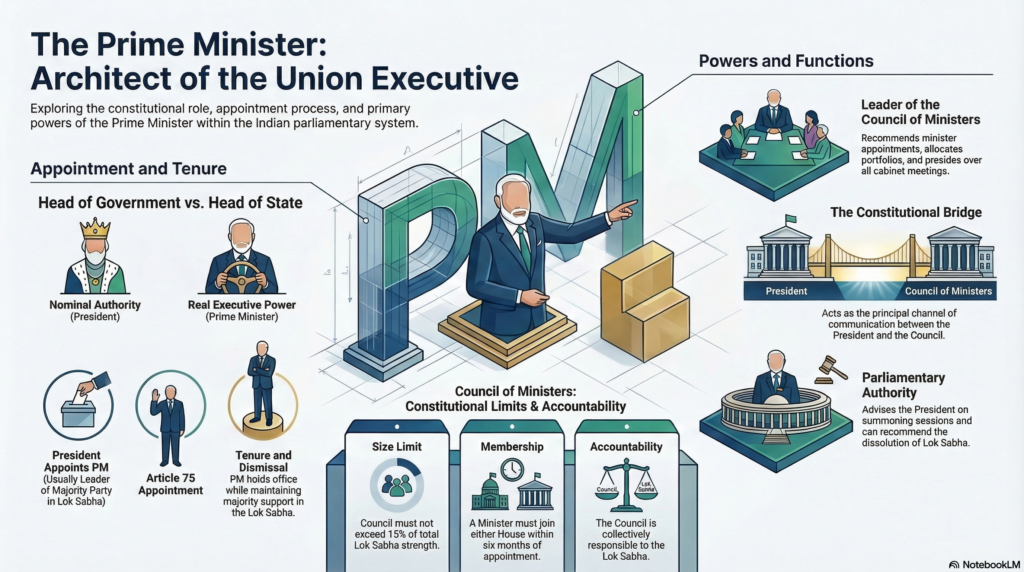
- Appointment: According to Article 75, the Prime Minister shall be appointed by the President. The Constitution has no specific procedure for selection. The President exercises individual judgment only if the PM dies suddenly and has no obvious successor.
- Constitutional provisions: Article 74 states there shall be a Council of Ministers with the Prime Minister as the head. Article 78 mandates the PM to communicate decisions and furnish info to the President.
- Position in the political system: The real executive authority (de facto executive) and the head of the government.
- Powers and functions: The PM decides the ranks of the ministers and allocates various portfolios to them. Acts as the chief coordinator of central administration through the Cabinet.
- Role in Council of Ministers: Head of the Council. If the PM loses the confidence of the Lok Sabha, they must resign, or the President can dismiss them.
- Relationship with President: The PM acts as a link. Under Article 78, the PM must communicate all CoM decisions regarding administration and legislation to the President, furnish required info, and submit matters for CoM consideration if the President asks.
SECTION 6: COUNCIL OF MINISTERS
- Articles related: Article 74 (Status of CoM to aid and advise President) and Article 75 (Appointment, tenure, responsibility, qualification, oath, salaries).
- Appointment: Appointed by the President on the advice of the Prime Minister. Oath of office and secrecy is administered by the President. Salaries and allowances are determined by Parliament.
- Composition: Consists of three categories: Cabinet Ministers, Ministers of State, and Deputy Ministers. The difference lies in their rank, emoluments, and political importance.
- Categories of ministers:
- Cabinet Ministers: Head important ministries (Home, Defence, Finance, External Affairs). Attend cabinet meetings and formulate policies.
- Ministers of State: Can be given independent charge of ministries or attached to Cabinet ministers.
- Deputy Ministers: Do not get independent charge; attached to Cabinet or State ministers to assist in administrative, political, and parliamentary duties.
- Collective responsibility: The Council of Ministers is collectively responsible. It aids and advises the President, and the President shall act in accordance with such advice (can ask for reconsideration once).
- Individual responsibility: Ministers hold office during the pleasure of the President. A minister can speak and take part in proceedings of both Houses but can only vote in the House they are a member of.
- Cabinet vs Council of Ministers:
- Cabinet: A smaller body of top ministers. It is the highest decision-making authority, chief policy-making body, chief crisis manager, and supreme executive authority. Its advice is binding on the President.
- Kitchen Cabinet: An even smaller, informal body consisting of the PM and 15-20 most important ministers. It is the highest decision-making body in the formal sense.
SECTION 7: IMPORTANT ARTICLES
| Article Number | Brief Explanation / Subject Matter |
| Article 13 | Defines ‘Law’ (Ordinance has the same force as law). |
| Article 52 | There shall be a President of India. |
| Article 53 | Executive power of the Union shall be vested in the President. |
| Article 54 | Election of the President (Electoral College details). |
| Article 55 | Manner of election of the President (STV & Value of Vote). |
| Article 56 | Term of office of the President. |
| Article 57 | Eligibility for Re-election of the President. |
| Article 58 | Qualifications for election as President. |
| Article 60 | Oath or affirmation by the President. |
| Article 61 | Procedure for Impeachment of the President. |
| Article 62 | Time for holding an election to fill a vacancy in the office of the President. |
| Article 63 | There shall be a Vice-President of India. |
| Article 64 | The Vice-President to be the ex-officio Chairman of the Council of States. |
| Article 65 | VP to act as President or discharge functions during vacancies/absence. |
| Article 66 | Election of Vice-President. |
| Article 67 | Term of office of Vice-President. |
| Article 68 | Time of holding election to fill VP vacancy. |
| Article 69 | Oath or affirmation by the Vice-President. |
| Article 70 | Discharge of President’s functions in other contingencies. |
| Article 71 | Supreme Court settles disputes regarding President/VP elections. |
| Article 72 | Pardoning power of the President. |
| Article 74 | Council of Ministers (with PM as head) to aid and advise the President. |
| Article 75 | Appointment, tenure, oath, salary, and responsibilities of Ministers. |
| Article 78 | Duties of PM regarding furnishing information to the President. |
| Article 110 | Money Bill. |
| Article 111 | Power of President to give assent to bills passed by Parliament. |
| Article 112 | Annual Financial Statement (Union Budget). |
| Article 123 | Ordinance-making power of the President. |
| Article 143 | Power of President to consult the Supreme Court. |
| Article 280 | Finance Commission. |
| Article 324 | Election Commission of India (conducts Presidential elections). |
| Article 352 | National Emergency. |
| Article 356 & 365 | President’s Rule (State Emergency). |
| Article 360 | Financial Emergency. |
SECTION 8: IMPORTANT FACTS FOR EXAMS
- Amendments:
- Citizenship Act (CA), 1955: Identifies 5 methods to gain citizenship (Birth, Descent, Registration, Naturalization, Incorporation of Territory) for Presidential eligibility.
- 84th Constitutional Amendment Act, 2001: Mandates using the 1971 census for Presidential election vote calculation until the first census after 2026.
- 104th Constitutional Amendment Act: Removed the nomination of Anglo-Indians to Lok Sabha and State Legislative Assemblies.
- 44th Constitutional Amendment Act, 1978: Added the word ‘Cabinet’ to Article 352.
- Historical Examples & Data:
- Since Neelam Sanjiva Reddy, all Presidents assume charge on 25th July.
- Presidential Election 2022 (16th Election): Droupadi Murmu vs Yashwant Sinha. 100% MLA voting in states like Kerala, Gujarat, etc. Eco-friendly green polling booth set up in Meghalaya.
- Supreme Court Precedents: Epuru Sudhakar vs. State of Andhra Pradesh (2006) established that the President’s pardoning power is not absolute and is subject to limited judicial review under Articles 32 and 226.
- Special constitutional provisions:
- An Ordinance has a maximum lifespan of 6 months and 6 weeks.
- For the VP election, proposers/seconders required are 20 each, while the President requires 50 each. Security deposit is ₹15,000 for both.
- The President’s address to Parliament is written by the Union Cabinet, not by the President.
- A sitting President, VP, Governor, or Minister is not deemed to hold an office of profit for election purposes.
SECTION 9: QUICK REVISION NOTES
- Government Setup: Legislature (Makes laws), Executive (Implements laws), Judiciary (Interprets laws). Separation of powers prevents tyranny.
- The President: Nominal Executive, Head of State. Elected indirectly via STV secret ballot by elected MPs and MLAs. Needs to be 35 years old. Oath by CJI. Impeached only for “violation of the constitution” by 2/3rd total majority in both houses (no state participation). Exercises Veto, Ordinance (max 6 months 6 weeks), and Pardoning powers.
- The Vice-President: Ex-officio Chairman of Rajya Sabha. Elected by ALL MPs (elected + nominated). Removed by an effective majority in RS and simple majority in LS. Acts as President if there is a vacancy.
- The Prime Minister: Real Executive, Head of Government. Appointed by the President. Forms the link between the President and the Cabinet. Allocates portfolios.
- Council of Ministers (CoM): Headed by the PM. Aids and advises the President (advice is binding). Three tiers: Cabinet Ministers, Ministers of State, Deputy Ministers. The Cabinet is the supreme policy-making and crisis management body.
Important Election Math: MLA Vote Value uses 1971 population. Deposit for Prez/VP is ₹15,000. If 1/6th valid votes are not achieved, deposit is forfeited
0 ONE-WORD / SHORT ANSWER QUESTIONS
- Which Article states that “There shall be a President of India”? Answer: Article 52.
- Under which system is the President of India elected? Answer: Proportional Representation by means of the Single Transferable Vote.
- What is the security deposit amount required for a Presidential or Vice-Presidential candidate? Answer: ₹15,000.
- Who administers the oath of office to the President of India? Answer: Chief Justice of India (or the senior-most judge of the Supreme Court in his absence).
- What is the fraction of total valid votes a Presidential candidate must secure to avoid forfeiting their security deposit? Answer: One-sixth (1/6th).
- How many proposers and seconders are required to nominate a candidate for the Vice-Presidential election? Answer: 20 proposers and 20 seconders.
- Which Article deals with the pardoning power of the President? Answer: Article 72.
- Which Indian President was the first to use the Pocket Veto, specifically on the Indian Post Office (Amendment) bill in 1986? Answer: President Zail Singh.
- What is the maximum lifespan of an Ordinance promulgated by the President? Answer: Six months and six weeks.
- According to the sources, from which country’s constitution is the office of the Vice-President modeled? Answer: America (USA).
- Who is the ex-officio Chairman of the Rajya Sabha? Answer: The Vice-President.
- Which Constitutional Amendment Act made it compulsory for the President to give his assent to a constitutional amendment bill? Answer: 24th Constitutional Amendment Act, 1971.
- Who is the real executive authority (de facto executive) of India? Answer: The Prime Minister.
- What is the minimum qualifying age for contesting the Presidential election? Answer: 35 years.
- In the case of a casual vacancy in the office of the President, within how many months must the election be held? Answer: Six months.
- Who decides on the disqualifications of Members of Parliament in consultation with the Election Commission? Answer: The President.
- Which Article empowers the President to promulgate Ordinances during the recess of Parliament? Answer: Article 123.
- Who settles all doubts and disputes arising out of the election of the President or Vice-President? Answer: The Supreme Court.
- Which census is used as the base population figure for calculating the value of votes in the Presidential Election until the first census after 2026? Answer: 1971 Census.
- Who writes/prepares the speech that the President reads while addressing the Parliament? Answer: The Union Cabinet.
——————————————————————————–
30 UPSC-STYLE STATEMENT QUESTIONS
Question 1 Consider the following statements regarding the Electoral College for the President’s election:
- It consists of the elected members of both Houses of Parliament.
- It includes the nominated members of State Legislative Assemblies. Which of the statements given above is/are correct? A) 1 only B) 2 only C) Both 1 and 2 D) Neither 1 nor 2 Answer: A (1 only). Nominated members of Parliament and State Assemblies are not eligible to be included.
Question 2 Consider the following statements:
- The President is the nominal executive authority (de jure executive).
- The Prime Minister is the real executive authority (de facto executive). Which of the statements given above is/are correct? A) 1 only B) 2 only C) Both 1 and 2 D) Neither 1 nor 2 Answer: C (Both 1 and 2).
Question 3 With reference to Ordinance-making powers, consider the following statements:
- Article 123 empowers the President to issue Ordinances.
- Article 213 empowers the Governor to issue Ordinances. Which of the statements given above is/are correct? A) 1 only B) 2 only C) Both 1 and 2 D) Neither 1 nor 2 Answer: C (Both 1 and 2).
Question 4 Consider the following statements regarding the Veto power of the President:
- In India, the President has to return a bill for reconsideration within 10 days.
- The Pocket Veto empowers the President to simply keep the bill pending for an indefinite period. Which of the statements given above is/are correct? A) 1 only B) 2 only C) Both 1 and 2 D) Neither 1 nor 2 Answer: B (2 only). It is the USA President who has to return the bill within 10 days, not the Indian President.
Question 5 Consider the following statements regarding the Impeachment of the President:
- The President can be impeached only for the “violation of the Constitution”.
- The impeachment resolution must be passed by a majority of not less than two-thirds of the members present and voting. Which of the statements given above is/are correct? A) 1 only B) 2 only C) Both 1 and 2 D) Neither 1 nor 2 Answer: A (1 only). The resolution must be passed by a majority of not less than two-thirds of the total membership of the House.
Question 6 Regarding the Vice-President’s election, consider the following statements:
- The Electoral College consists of both elected and nominated members of Parliament.
- Elected members of State Legislative Assemblies are also part of this Electoral College. Which of the statements given above is/are correct? A) 1 only B) 2 only C) Both 1 and 2 D) Neither 1 nor 2 Answer: A (1 only). The VP’s electoral college does not include members of the state legislative assemblies.
Question 7 With reference to the pardoning power of the President (Article 72), consider the following statements:
- The President can grant pardons in all cases where the sentence is a sentence of death.
- The President’s power takes away the power conferred by law on military officers to suspend or remit a Court Martial sentence. Which of the statements given above is/are correct? A) 1 only B) 2 only C) Both 1 and 2 D) Neither 1 nor 2 Answer: A (1 only). Article 72 does not affect/take away the power conferred by law on military officers to deal with Court Martial sentences.
Question 8 Consider the following statements about the President’s assent to bills:
- The President can return a Money Bill for the reconsideration of Parliament.
- If a bill is passed again by Parliament, with or without amendments, the President has to give his assent. Which of the statements given above is/are correct? A) 1 only B) 2 only C) Both 1 and 2 D) Neither 1 nor 2 Answer: B (2 only). The President cannot return a Money Bill for reconsideration.
Question 9 With reference to the qualifications of the Vice-President, consider the following:
- He should be qualified for election as a member of the Lok Sabha.
- He should have completed 35 years of age. Which of the statements given above is/are correct? A) 1 only B) 2 only C) Both 1 and 2 D) Neither 1 nor 2 Answer: B (2 only). The Vice-President must be qualified for election as a member of the Rajya Sabha, not Lok Sabha.
Question 10 Regarding the Union Council of Ministers, consider the following statements:
- Article 74 states there shall be a Council of Ministers with the Prime Minister at the head to aid and advise the President.
- The President cannot require the Council of Ministers to reconsider such advice under any circumstances. Which of the statements given above is/are correct? A) 1 only B) 2 only C) Both 1 and 2 D) Neither 1 nor 2 Answer: A (1 only). The President may require the Council of Ministers to reconsider such advice.
Question 11 Consider the following statements about the term and vacancy of the President:
- An election to fill a vacancy caused by the death or resignation of the President must be held within six months.
- The person elected to fill the vacancy holds office only for the unexpired portion of the term. Which of the statements given above is/are correct? A) 1 only B) 2 only C) Both 1 and 2 D) Neither 1 nor 2 Answer: A (1 only). The newly elected President gets a full 5-year term from the date of entering office, not just the remaining period.
Question 12 Consider the following statements regarding the eligibility for re-election of the President (Article 57):
- The Constitution places a strict limit allowing a person to serve a maximum of two terms as President.
- A person who holds or has held the office of President is eligible for re-election. Which of the statements given above is/are correct? A) 1 only B) 2 only C) Both 1 and 2 D) Neither 1 nor 2 Answer: B (2 only). The Constitution puts no restriction on the number of times a person can be elected.
Question 13 Consider the following statements regarding the “Office of Profit” condition for the President’s election:
- A sitting Governor of any state is deemed to hold an office of profit.
- A sitting Vice-President of the Union is not deemed to hold an office of profit. Which of the statements given above is/are correct? A) 1 only B) 2 only C) Both 1 and 2 D) Neither 1 nor 2 Answer: B (2 only). A sitting President, Vice-President, Governor, or Minister is not deemed to hold an office of profit.
Question 14 With reference to the Military Powers of the President, consider the following statements:
- He is the supreme commander of the defence forces of India.
- He can declare war independently without the approval of the Parliament. Which of the statements given above is/are correct? A) 1 only B) 2 only C) Both 1 and 2 D) Neither 1 nor 2 Answer: A (1 only). The declaration of war or conclusion of peace is subject to the approval of the Parliament.
Question 15 Consider the following statements regarding Parliamentary procedures:
- The President can appoint any member of the Lok Sabha to preside over it when the offices of both Speaker and Deputy Speaker fall vacant.
- The President’s prior recommendation is required to introduce a bill for the alteration of boundaries of states. Which of the statements given above is/are correct? A) 1 only B) 2 only C) Both 1 and 2 D) Neither 1 nor 2 Answer: C (Both 1 and 2).
Question 16 Regarding the promulgation of Ordinances under Article 123, consider the following:
- An Ordinance can be promulgated only when both Houses of Parliament are not in session.
- If an Ordinance contains a provision that Parliament itself has no constitutional power to make, it shall be void. Which of the statements given above is/are correct? A) 1 only B) 2 only C) Both 1 and 2 D) Neither 1 nor 2 Answer: C (Both 1 and 2).
Question 17 Consider the following statements on the duration of an Ordinance:
- It ceases to operate at the expiration of six weeks from the reassembly of Parliament.
- If the Houses of Parliament are summoned to reassemble on different dates, the period of six weeks is reckoned from the earlier date. Which of the statements given above is/are correct? A) 1 only B) 2 only C) Both 1 and 2 D) Neither 1 nor 2 Answer: A (1 only). The six weeks are calculated from the later of the two dates.
Question 18 Consider the following statements regarding the Vice-President:
- He is the ex-officio Chairman of the Council of States.
- While acting as President, he simultaneously performs the duties of the Chairman of Rajya Sabha. Which of the statements given above is/are correct? A) 1 only B) 2 only C) Both 1 and 2 D) Neither 1 nor 2 Answer: A (1 only). While acting as President, he ceases to perform the duties of the Chairman of Rajya Sabha [34, inferred from general polity but based strictly on source: Art 64 says ex-officio chairman].
Question 19 With reference to the executive system, consider the following:
- The Permanent Executive consists of the bureaucracy (All India Services, Central Services).
- The Political Executive consists of the President, Prime Minister, and Council of Ministers. Which of the statements given above is/are correct? A) 1 only B) 2 only C) Both 1 and 2 D) Neither 1 nor 2 Answer: C (Both 1 and 2).
Question 20 Consider the following appointments made by the President of India:
- Chairman of the Union Public Service Commission.
- The Chief Election Commissioner.
- The Attorney General of India. Which of the appointments listed above are made by the President? A) 1 and 2 only B) 2 and 3 only C) 1 and 3 only D) 1, 2, and 3 Answer: D (1, 2, and 3).
Question 21 Consider the following statements based on Article 78 regarding the Prime Minister:
- It is the duty of the PM to communicate to the President all decisions of the council of ministers relating to administration.
- The President has no authority to call for information from the PM relating to proposals for legislation. Which of the statements given above is/are correct? A) 1 only B) 2 only C) Both 1 and 2 D) Neither 1 nor 2 Answer: A (1 only). The President can call for such information under Article 78(b).
Question 22 Regarding the value of votes in the Presidential Election, consider the following:
- The value of the vote of an MLA depends on the population of the respective State.
- The value of the vote of an MP is obtained by dividing the total number of votes assigned to all elected MLAs by the total number of elected MPs. Which of the statements given above is/are correct? A) 1 only B) 2 only C) Both 1 and 2 D) Neither 1 nor 2 Answer: C (Both 1 and 2).
Question 23 Consider the following statements about the Election Commission and Presidential Polls:
- The Election Commission conducts the election for the office of the President.
- The Returning Officers for the Presidential election are rotated between the Secretary-Generals of the Rajya Sabha and Lok Sabha. Which of the statements given above is/are correct? A) 1 only B) 2 only C) Both 1 and 2 D) Neither 1 nor 2 Answer: C (Both 1 and 2).
Question 24 Consider the following situations for the Presidential veto on a state bill reserved by the Governor (Article 201):
- The President can direct the Governor to return the bill (if not a money bill) for reconsideration.
- If the state legislature passes the bill again and sends it to the President, the President is constitutionally bound to give assent. Which of the statements given above is/are correct? A) 1 only B) 2 only C) Both 1 and 2 D) Neither 1 nor 2 Answer: A (1 only). It is not obligatory for the President to give his assent even if the state legislature passes it again (Discretionary).
Question 25 Consider the following regarding the Rajya Sabha:
- One-third of its members retire every two years.
- Rajya Sabha has the power to mandate the Parliament to create a new All India Service. Which of the statements given above is/are correct? A) 1 only B) 2 only C) Both 1 and 2 D) Neither 1 nor 2 Answer: C (Both 1 and 2).
Question 26 Consider the following statements regarding the President’s personal immunity:
- The President enjoys personal immunity from legal liability for his official acts.
- Criminal proceedings can be initiated against the President during his term of office if two months’ prior notice is given. Which of the statements given above is/are correct? A) 1 only B) 2 only C) Both 1 and 2 D) Neither 1 nor 2 Answer: A (1 only). He is completely immune from criminal proceedings. Two months’ notice applies only to civil proceedings for personal acts.
Question 27 Consider the following Articles related to Emergency Powers of the President:
- Article 352 relates to National Emergency.
- Article 360 relates to President’s Rule. Which of the statements given above is/are correct? A) 1 only B) 2 only C) Both 1 and 2 D) Neither 1 nor 2 Answer: A (1 only). Article 360 relates to Financial Emergency. President’s Rule is under 356 & 365.
Question 28 With reference to diplomatic powers, consider the following statements:
- International treaties and agreements are negotiated and concluded on behalf of the Prime Minister.
- The President represents India in international forums and affairs and sends and receives diplomats. Which of the statements given above is/are correct? A) 1 only B) 2 only C) Both 1 and 2 D) Neither 1 nor 2 Answer: B (2 only). International treaties are negotiated and concluded on behalf of the President.
Question 29 Consider the following statements regarding the election to fill the vacancy in the office of Vice-President:
- If an MP or MLA gets elected as Vice-President, they automatically lose their seat on the day they assume office.
- A person must not be a member of Parliament while holding the office of the Vice-President. Which of the statements given above is/are correct? A) 1 only B) 2 only C) Both 1 and 2 D) Neither 1 nor 2 Answer: C (Both 1 and 2).
Question 30 With reference to the structure of the Union Executive, which of the following are components?
- The President
- The Vice-President
- The Attorney General of India Select the correct answer using the code given below: A) 1 and 2 only B) 2 and 3 only C) 1 and 3 only D) 1, 2, and 3 Answer: D (1, 2, and 3). The Union Executive consists of the President, Vice President, PM, CoM, and Attorney General.