
Right to Information (RTI) Act
Learn the key provisions of the RTI Act 2005 with concise PSC-oriented notes covering objectives, application procedure, appeals, and penalties.
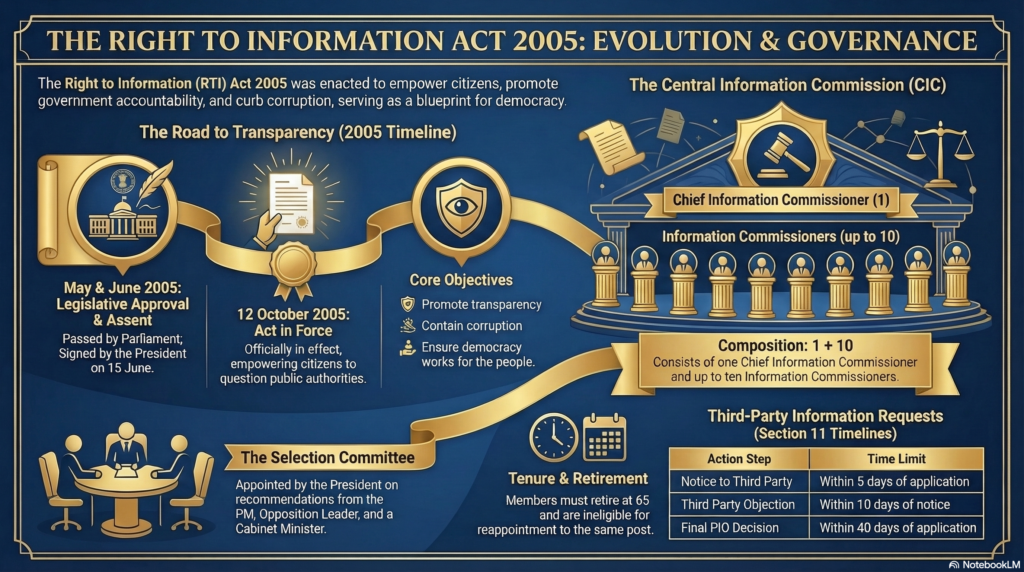
📖 Right to Information (RTI) Act, 2005: Kerala PSC Study Notebook
1️⃣ Introduction to Right to Information
- Meaning: The Right to Information (RTI) empowers citizens to seek information from the government and public utility service providers, ensuring transparency and accountability.
- Fundamental Right Connection: RTI is considered a fundamental right under Article 19(1)(a) of the Indian Constitution, which guarantees the Freedom of Speech and Expression. This was established by the Supreme Court in the 1976 Raj Narain vs. State of Uttar Pradesh case.
- Historical Background: The Mazdoor Kisan Shakti Sanghatan (MKSS) in Rajasthan, spearheaded by Aruna Roy, led the grassroots movement for the RTI Act. Tamil Nadu was the first Indian state to pass an RTI Act indigenously in 1997, and Rajasthan enacted it in 2000.
- Timeline of RTI Act 2005:
- Passed by Lok Sabha: 11 May 2005.
- Passed by Rajya Sabha: 12 May 2005.
- Signed by the President (A.P.J. Abdul Kalam): 15 June 2005.
- Came into force: 12 October 2005.
- The RTI Act 2005 replaced the earlier Freedom of Information Act, 2002.
2️⃣ Objectives of the RTI Act
The fundamental objectives of the Act are to:
- Empower citizens to question the government.
- Promote transparency and accountability in the working of every public authority.
- Contain and reduce corruption in public offices.
- Ensure people’s participation in governance, making democracy work for the people in a real sense.
- Build better-informed citizens who keep a vigil on government machinery.
3️⃣ Right to Information and Public Authorities
- Public Authority [Section 2(h)]: Any authority, body, or institution established by the Constitution, Parliament, or State Legislature, including bodies substantially financed by the appropriate Government. Private institutions whose information is accessed by a public authority under existing law also fall under the act.
- Duties of Public Authorities:
- Maintain all records duly catalogued and indexed in a manner that facilitates RTI.
- Ensure records appropriate for computerization are computerized within a reasonable time and connected through a nationwide network to facilitate easy access.
- Citizens have the right to inspect documents, take notes, take certified samples, and obtain copies (printouts, CDs, floppies).
4️⃣ Information Commissions
Central Information Commission (CIC)
- Appointment: The Chief Information Commissioner and Information Commissioners (up to 10) are appointed by the President on the recommendation of a committee.
- Committee Members: The Prime Minister (Chairperson), Leader of Opposition in the Lok Sabha, and a Union Cabinet Minister nominated by the PM.
- Eligibility: Must be persons of eminence in public life with wide knowledge and experience in law, science and technology, social service, management, journalism, mass media, or administration.
- Term & Age Limit: The maximum age limit is 65 years. They cannot hold office after attaining 65 years. The term length is determined by the Central Government.
- Removal: By the President on grounds of proved misbehaviour/incapacity, insolvency, moral turpitude, or engaging in paid employment outside duties.
State Information Commission (SIC)
- Structure: Headed by the State Chief Information Commissioner and assisted by State Information Commissioners.
- Appointment: Appointed by the Governor.
- Functions & Powers [Section 18]: Receives and inquires into complaints from persons who have been refused access to information, received false/misleading info, or faced unreasonable fees. The Commission holds the powers of a civil court (summoning persons, requiring discovery of documents, receiving evidence on affidavit).
5️⃣ Public Information Officers
- Central/State Public Information Officer (CPIO/SPIO): They are the designated officers within public authorities responsible for receiving requests and providing information. They have full authority to dispose of RTI applications.
- Assistant Public Information Officer (APIO): Their primary duty is to receive applications and appeals and forward them to the CPIO/SPIO or the appellate authority within 5 days. Note: An APIO does not have the authority to provide information directly.
6️⃣ RTI Application Procedure
- How to Apply: Applications can be submitted in writing or electronically. If the applicant cannot write, the PIO must assist them in reducing it to writing.
- Language: English, Hindi, or the official regional language.
- Details Required: The applicant is not required to give any reason for requesting the information or provide any personal details other than contact information.
- Application Fee: ₹10 (often affixed as a court fee stamp).
- BPL Exemption: Persons Below Poverty Line (BPL) are exempt from paying the application fee upon producing proof.
- Other Fees: ₹3 per A4/A3 page, actual cost for larger papers/samples, ₹75 for electronic mode. Inspection of records is free for the first hour, and ₹10 for every subsequent 30 minutes.
7️⃣ Time Limits in RTI
| Action / Situation | Time Limit |
| Normal Information Provision | 30 days |
| Information affecting Life or Liberty | 48 hours |
| Application submitted through APIO | 35 days (30 + 5 days) |
| Transferring application to another Public Authority | 5 days |
| Involving Third-Party Information | 40 days (Notice in 5 days, 10 days for objection) |
| First Appeal to Senior Officer | Within 30 days |
| Second Appeal to Information Commission | Within 90 days |
8️⃣ Third Party Information [Section 11]
- Meaning [Section 2(n)]: A person other than the citizen making the request, which also includes a public authority.
- Procedure: If the requested information involves a third party, the PIO must issue a written notice to the third party within 5 days of receiving the application.
- Opportunity to Object: The third party has 10 days from receiving the notice to make an oral or written representation against disclosure. The PIO takes a final decision within 40 days after considering this submission.
9️⃣ Grounds for Rejection of Information
- Section 8(1) Exemptions: The PIO has no obligation to give information that:
- Affects sovereignty, integrity, or security of India.
- Is expressly forbidden by a court or constitutes contempt of court.
- Causes a breach of privilege of Parliament or State Legislature.
- Involves trade secrets, commercial confidence, or intellectual property.
- Is received in confidence from a foreign government.
- Endangers life or physical safety.
- Impedes the process of investigation, apprehension, or prosecution.
- Cabinet papers (though decisions/reasons must be public after the matter is complete).
- Personal information with no public interest.
- Section 9 (Copyright): A request can be rejected if providing access involves an infringement of copyright subsisting in a person other than the State.
- The 20-Year Rule: Under Section 8(3), information relating to any event that happened 20 years before the request date must be provided, subject to certain clauses.
🔟 Appeals under RTI
- First Appeal [Section 19(1)]: If no decision is received within the time limit or the applicant is aggrieved by the PIO’s decision, they can file an appeal to an officer senior in rank to the PIO within 30 days.
- Second Appeal [Section 19(3)]: Filed before the Central or State Information Commission within 90 days from the date the decision should have been made or was actually received.
1️⃣1️⃣ Penalties under RTI [Section 20]
- The Commission can impose penalties on the SPIO/CPIO if they:
- Refuse to accept an application without reason.
- Do not provide info within the time limit.
- Deny the request with bad faith.
- Knowingly give incomplete, misleading, or false information.
- Fine Amount: ₹250 per day until the application is received or information furnished.
1️⃣2️⃣ RTI Amendment Act 2019
- Key Dates: Introduced in Lok Sabha (July 19, 2019), passed by LS (July 22), passed by RS (July 25), and signed by President on August 1, 2019.
- Sections Amended: Sections 13, 16, and 27.
- Major Changes: Previously, the term was fixed at 5 years, and salaries were equivalent to Election Commissioners. The 2019 amendment empowered the Central Government to notify/determine the tenure, salaries, allowances, and other terms of service for both Central and State Information Commissioners.
1️⃣3️⃣ Important Schedules of RTI Act
The Act contains 2 Schedules:
- First Schedule: Contains the format for the Oath of the Chief Information Commissioner and Information Commissioners.
- Second Schedule [Section 24]: Lists intelligence and security organizations established by the Central Government that are exempted from the purview of the Act (e.g., IB, RAW, Border Security Force, NCB, Enforcement Directorate). Exception: Information regarding allegations of corruption and human rights violations are not excluded.
——————————————————————————–
📝 PSC Exam Preparation Section
(Note: To ensure a high-quality review within limits, a curated selection of the most critical exam questions is provided based strictly on the uploaded PDFs.)
🎯 20 One-Line Facts for Quick Revision
- The RTI Act came into force fully on October 12, 2005.
- The RTI Act is an extension of the Fundamental Right under Article 19(1)(a).
- Aruna Roy spearheaded the Mazdoor Kisan Shakti Sanghatan (MKSS) which led the RTI movement.
- The RTI Act contains 6 Chapters, 31 Sections, and 2 Schedules.
- Application fee for RTI is ₹10.
- BPL (Below Poverty Line) citizens are exempt from RTI application fees.
- Normal time limit for PIO to provide information is 30 days.
- If information concerns life and liberty, it must be provided within 48 hours.
- An APIO has a time limit of 5 extra days (total 35 days) to forward the application.
- The maximum age for holding office as a Chief Information Commissioner is 65 years.
- Penalty for delaying information is ₹250 per day.
- Section 8 deals with the exemption from disclosure of information.
- Section 9 allows rejection of RTI if it infringes on copyright belonging to a third party.
- Under Section 11, a third party must be given notice within 5 days.
- A First Appeal under RTI must be filed within 30 days.
- A Second Appeal must be filed before the Information Commission within 90 days.
- The RTI Amendment Act 2019 was signed by President Ram Nath Kovind on August 1, 2019.
- The Second Schedule lists intelligence and security organizations exempted from RTI.
- An RTI applicant does not need to provide a reason for requesting information.
- Under RTI, if the PIO fails to reply within the time limit, the information must be provided free of cost.
💡 10 Short Notes
- Meaning of Information [Sec 2(f)]: Any material in any form including records, documents, memos, emails, logbooks, samples, models, and electronic data.
- Third Party [Sec 2(n)]: A person other than the citizen making the request. It includes public authorities as well.
- APIO Responsibilities: Assistant Public Information Officers do not provide information directly. They receive applications/appeals and forward them to the SPIO/CPIO within 5 days.
- Sections Amended in 2019: The 2019 RTI Amendment altered Sections 13, 16, and 27, transferring the power to determine the term and salaries of Information Commissioners to the Central Government.
- Section 24 (Exemptions): Certain intelligence agencies (IB, RAW, ED, NCB) listed in the Second Schedule are exempt from the RTI Act unless the request pertains to corruption or human rights violations.
- Fee Structure: Application fee is ₹10. Copies cost ₹3 per A4/A3 page. Electronic information costs ₹75. Inspection is free for the first hour.
- Second Appeal: If unsatisfied with the First Appellate Authority’s decision, an applicant can approach the Central/State Information Commission within 90 days of receiving the decision.
- CIC Appointment Committee: Consists of the Prime Minister, Leader of Opposition in Lok Sabha, and a Union Cabinet Minister nominated by the PM.
- Penalties [Sec 20]: If a PIO deliberately denies info, delays it, or gives false info, a penalty of ₹250/day is levied.
- The 20-Year Rule: Under Section 8(3), information relating to an event that occurred 20 years before the date of request must generally be provided, overriding many standard exemptions.
✍️ 5 Descriptive Questions for Practice
- Explain the procedure for dealing with ‘Third Party Information’ under the RTI Act, 2005. (Hint: Define 3rd party, mention the 5-day notice, 10-day objection period, and 40-day final decision limit).
- Discuss the exemptions from disclosure of information as per Section 8(1) of the RTI Act. (Hint: Detail exemptions like national security, trade secrets, cabinet papers, and foreign confidence).
- Detail the time limits stipulated in the RTI Act for providing information under various circumstances. (Hint: Outline the 30-day, 48-hour, 35-day, and 40-day rules).
- What are the key changes introduced by the RTI Amendment Act of 2019? (Hint: Focus on changes to Sections 13, 16, 27, and changes to the term length and salary determination of Commissioners).
- Elaborate on the role, powers, and penalizing authority of the Central/State Information Commissions. (Hint: Powers of a civil court, inquiring into delays/false info, and imposing ₹250/day penalties).
📝 15 Multiple Choice Questions (MCQs)
1. The Right to Information Act came into force on: A) 15 June 2005 B) 12 October 2005 C) 11 May 2005 D) 1 August 2019 Answer: B
2. Information concerning the life and liberty of a person must be provided within: A) 30 days B) 35 days C) 48 hours D) 24 hours Answer: C
3. The maximum age limit for the Chief Information Commissioner is: A) 60 years B) 62 years C) 65 years D) No age limit Answer: C
4. Under the RTI Act, 2005, the application fee is: A) ₹20 B) ₹50 C) ₹10 D) Free for everyone Answer: C
5. Which section of the RTI Act deals with Exemption from Disclosure of Information? A) Section 4 B) Section 8 C) Section 11 D) Section 20 Answer: B
6. If an application is submitted through an Assistant Public Information Officer (APIO), how many additional days are added to the time limit? A) 3 days B) 5 days C) 10 days D) 15 days Answer: B
7. A First Appeal under the RTI Act must be filed within: A) 15 days B) 30 days C) 45 days D) 90 days Answer: B
8. Which of the following is NOT exempt under Section 8 of the RTI Act? A) Cabinet papers before a decision is finalized B) Information endangering national security C) Information regarding allegations of corruption in exempt security organizations D) Trade secrets of a third party Answer: C
9. The Second Schedule of the RTI Act lists: A) The oath of the Information Commissioners B) The duties of Public Authorities C) Exempted intelligence and security organizations D) Fee structures Answer: C
10. The penalty for delaying information without a reasonable cause is: A) ₹100 per day B) ₹250 per day C) ₹500 per day D) ₹1000 per day Answer: B
11. Who spearheaded the Mazdoor Kisan Shakti Sanghatan (MKSS) movement? A) Medha Patkar B) Anna Hazare C) Aruna Roy D) Arvind Kejriwal Answer: C
12. Which sections were amended by the RTI Amendment Act, 2019? A) Sections 10, 12, 15 B) Sections 13, 16, 27 C) Sections 8, 9, 11 D) Sections 19, 20, 21 Answer: B
13. A third party must be given an opportunity to object to the disclosure of their information within how many days of receiving the notice? A) 5 days B) 10 days C) 15 days D) 30 days Answer: B
14. An applicant making a request for information is required to give: A) Complete background and occupation details B) Valid reasons for requesting the information C) Only contact details necessary to contact them D) Proof of Indian citizenship Answer: C
15. If a PIO fails to reply within the prescribed time limit, the information must be provided to the applicant: A) With double the fee B) Free of cost C) Only after a first appeal D) With a standard ₹10 fee Answer: B