
KERALA PSC STUDY NOTEBOOK: INDIAN NATIONAL CONGRESS (INC)
India’s Historic Political Movement
INDIAN NATIONAL CONGRESS (INC)
The Indian National Congress is one of India’s oldest and most influential political parties, playing a key role in the country’s freedom movement and democratic development. Founded in 1885, the Congress continues to shape national policies and political discourse across India.
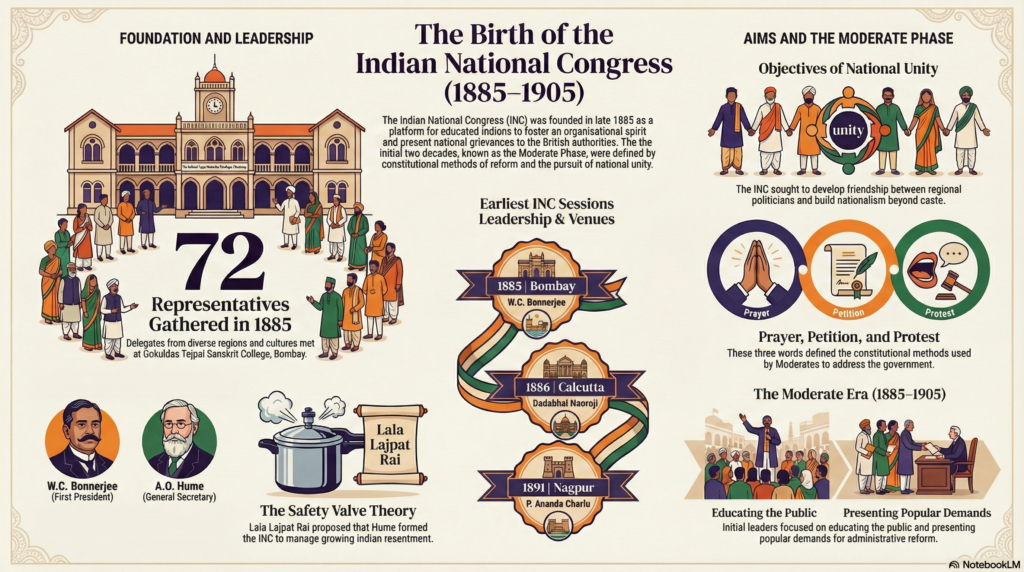
- INC FORMATION & BACKGROUND
- Background: After 1858, educated Indians were the ones who fostered an organizational spirit among the common people of India.
- Date of Formation: December 28, 1885.
- First Venue: Gokuldas Tejpal Sanskrit College, Bombay. (Note: The venue was shifted from Pune to Bombay due to a plague outbreak)
- Founder/Leader: A.O. Hume, an English official.
- Viceroy during Formation: Lord Dufferin, who initially supported the formation.
- First General Secretary: A.O. Hume.
- First President: W.C. Banerjee.
- First Resolution Presenter: G. Subramanya Iyer.
- First Malayali to Participate: Barrister G.P. Pillai.
- Number of Representatives in the first session: 72.
- First Session Quote: “We want the governance system in India to be more civilised and we also want to be involved in governance” – W.C. Banerjee.
- Major Aims of First Phase: Develop friendship bonds between politicians from different regions, foster nationalism beyond caste/religion/local thinking, and bring Indian problems to the authorities’ attention.
- PHASES OF THE NATIONAL MOVEMENT (As per SCERT)
- National movements against British rule are divided into 3 phases based on the method of struggle:
- Moderate Phase (1885 – 1905): Led initially by English-educated Indians like Dadabhai Naoroji, Gopal Krishna Gokhale, Badruddin Tyabji, and Pherozeshah Mehta. Their actions are summed up in three words: Prayer, Petition, and Protest.
- Extremist Phase (1905 – 1919).
- Gandhian Era (1919 – 1947).
- KEY THEORIES & COMMITTEES
- Safety Valve Theory: Proposed by Lala Lajpat Rai. It suggested that A.O. Hume formed the INC to act as a “safety valve” to prevent or reverse the growing resentment against the British among educated Indians.
- United India Patriotic Association (1888): An organization formed by Sir Syed Ahmed Khan specifically against the INC.
- INC British Committee (1889): Formed in England to bring British deeds in India to the attention of the British public. Its official magazine was “India”. William Wedderburn was its first chairman and William Digby was the secretary. (A branch of INC was also formed in London in 1888 conducted by William Digby).
- CHRONOLOGICAL SUMMARY OF MAJOR INC SESSIONS
- 1885 (Bombay): W.C. Banerjee (First President).
- 1886 (Calcutta): Dadabhai Naoroji (First Parsi President, Oldest age President).
- 1887 (Madras): Badruddin Tyabji (First Muslim President; First session held in South India).
- 1888 (Allahabad): George Yule (First Foreign President).
- 1889 (Bombay): William Wedderburn (Second Foreign President; First foreigner to be president twice – again in 1910).
- 1890 (Calcutta): Pherozeshah Mehta (Second Parsi President).
- 1891 (Nagpur): P. Ananda Charlu (First South Indian to be INC President).
- 1894 (Madras): Alfred Webb (Third Foreign President).
- 1896 (Calcutta): Rahmathullah Sayani. “Vande Mataram” was first sung by Rabindranath Tagore.
- 1897 (Amravati): C. Sankaran Nair (First Malayali to become INC President).
- 1901 (Calcutta): D.E. Wacha. (First INC session where Gandhiji participated).
- 1904 (Bombay): Henry Cotton (Fourth Foreign President).
- 1905 (Banaras): Gopal Krishna Gokhale. The “Swadeshi” slogan was first raised. Conference during the Bengal Partition.
- 1906 (Calcutta): Dadabhai Naoroji. The term “Swaraj” was used for the first time.
- 1907 (Surat): Rash Behari Ghosh. Surat Split – INC split into moderates and extremists.
- 1911 (Calcutta): B.N. Dhar. “Jana Gana Mana” was first sung by Saraladevi Chaudhurani.
- 1912 (Bankipur, Bihar): R.N. Mudholkar. First session where Jawaharlal Nehru participated.
- 1916 (Lucknow): A.C. Majumdar. Lucknow Pact signed between Congress and Muslim League. Moderates and Extremists decided to work together. Gandhi and Nehru met for the first time.
- 1917 (Calcutta): Annie Besant (First Woman & First Foreign Woman President).
- 1920 (Calcutta – Special): Lala Lajpat Rai. Resolution passed for the Non-Cooperation Movement (NCM).
- 1920 (Nagpur): C. Vijayaraghavachariar. NCM was formally approved.
- 1921 (Ahmedabad): C.R. Das (Arrested). Hakim Ajmal Khan became the First Acting President of INC. Kerala Renaissance leader V.T. Bhattathiripad participated.
- 1922 (Gaya): C.R. Das. Announced the formation of the Swaraj Party.
- 1923 (Kakinada): Maulana Mohammad Ali. T.K. Madhavan presented a resolution demanding nationwide action on Untouchability (leading to Vaikom Satyagraha).
- 1924 (Belgaum): Gandhiji (His first and only conference as President).
- 1925 (Kanpur): Sarojini Naidu (First Indian Woman President). Hindi was chosen as the official language.
- 1927 (Madras): M.A. Ansari. Motion to boycott the Simon Commission. Resolution passed that India’s future constitution should be based on fundamental rights.
- 1928 (Calcutta): Motilal Nehru. Nehru Report presented.
- 1929 (Lahore): Jawaharlal Nehru. Poorna Swaraj resolution passed. Decided to celebrate 26th Jan 1930 as Independence Day. Nehru hoisted the flag on the Ravi river banks on Dec 31, 1929. Decided to start Civil Disobedience.
- 1931 (Karachi): Sardar Vallabhbhai Patel. Signed Fundamental Rights for India and passed a resolution on economic policy.
- 1933 (Calcutta): Nellie Sengupta (Third woman President).
- 1934 (Bombay): Dr. Rajendra Prasad. Demanded a Constituent Assembly (raised by M.N. Roy). Gandhiji announced he was leaving Congress.
- 1935 (Bombay): Dr. Rajendra Prasad. First conference where the need for a constitution was discussed.
- 1937 (Faizpur, Maharashtra): J. Nehru. First INC meeting held in a village. Fiftieth Conference. Constitution idea officially put forward.
- 1938 (Haripura): Subhash Chandra Bose (First time as President).
- 1939 (Tripuri): First election for INC President post. Subhash Chandra Bose defeated Pattabhi Sitaramayya (Gandhiji’s representative). Bose resigned later, Rajendra Prasad became president. Bose formed the Forward Bloc.
- 1942 (Bombay): Maulana Abul Kalam Azad. Passed the Quit India Motion.
- 1946 (Meerut): J.B. Kripalani. President when India gained independence.
- 1948 (Jaipur): Pattabhi Sitaramayya. First President and first session after independence.
- 1950 (Nashik): Purushottam Das Tandon. Conference when India became a Republic.
- 1955 (Avadi, TN): U.N. Dhebar. Formulated the policy of Socialist Social Structure for India.
- WOMEN IN INC
- First woman to attend INC conference: Pandita Ramabai (1889, Bombay).
- First woman to address the INC: Kadambini Ganguly.
- First Woman / First Foreign Woman President: Annie Besant (1917, Calcutta).
- Second Woman / First Indian Woman President: Sarojini Naidu (1925, Kanpur).
- Third Woman / Second Foreign Woman President: Nellie Sengupta (1933, Calcutta).
- Fourth Woman / First Woman President after Independence: Indira Gandhi (1959).
- Longest-serving Woman President after Independence: Sonia Gandhi.
- KEY PERSONALITIES IN-DEPTH
- Dadabhai Naoroji:
- Born in Bombay in 1825.
- Gave the name to the “Indian National Congress”.
- Used the term “Swaraj” for the first time.
- First Parsi President of INC (President 3 times: 1886, 1893, 1906).
- Started Rahnuma Mazda Yasnan for the reformation of the Parsi religion.
- Started Gyan Prasarak Mandali with the aim of educating senior citizens.
- Led the formation of the Bombay Presidency Association (along with Pherozeshah Mehta, K.T. Telang, Badruddin Tyabji).
- Inventor of the Drain Theory: Stated that India’s wealth was siphoned to England in the form of salaries, gifts, and taxes, which was the root cause of India’s poverty.
- Pandita Ramabai:
- Mastered Sanskrit, Marathi, and Bengali languages.
- Given the title ‘Pandita’ by the teachers of Calcutta University.
- Founded organizations: Arya Mahila Samaj, Sharada Sadan (for widow rehabilitation), and Mukti Mission (for women’s vocational training).
- C. Sankaran Nair:
- First Malayali INC President (1897). Served in the Viceroy’s Executive Council. Wrote the book “Gandhi and Anarchy” (1922) which criticized Gandhiji’s methods.
- FACTS ON NATIONAL SONGS
- Vande Mataram: First sung in 1896 Calcutta session. Written by Bankim Chandra Chatterjee (taken from the novel Anandamath). Later published in Tatwabodhini magazine. Translated to English by Aurobindo Ghosh, to Tamil by Subramanya Bharathi, and to Malayalam by Kuttipurath Keshavan Nair.
- Jana Gana Mana: First sung in 1911 Calcutta session by Saraladevi Chaudhurani. Written by Rabindranath Tagore and translated into English by Tagore himself.
- FAMOUS QUOTES ABOUT INC
- “An English knowing upper class affairs” – Jawaharlal Nehru.
- “Microscopic minority” – Lord Dufferin.
- “My goal is a peaceful end to the Congress” – Lord Curzon.
- “No point crying like frogs once a year” – Bal Gangadhar Tilak.
- “Three days of fun” – Ashwini Kumar Datta.
- “Begging Institution” – Aurobindo Ghosh.
- “Formed from mystery” – Pattabhi Sitaramayya.
- “Formed from the efforts of talented Indians” – A.O. Hume.
- “Brilliance of Lord Dufferin” – Lala Lajpat Rai.
- “A factory of treason” – British.