Indian Polity | Elections & Constitutional BodiesAdd an
indian-election-system-political-parties-human-rights-commission-notes
Learn the complete Indian election system including Article 324, Election Commission of India, Representation of People Acts (1950 & 1951), political party recognition, EVM & VVPAT, Model Code of Conduct, and NHRC/SHRC. Detailed notes with MCQs for PSC, UPSC, and competitive exams.
The Constitutional Backbone: Rules of the Game
The foundation of Indian elections is laid out in Part XV of the Constitution, specifically Articles
324 through 329.
- The Supreme Authority: Article 324 vests the superintendence, direction, and control of all
elections (Parliament, State Legislatures, President, Vice-President) in a single independent
body: the Election Commission of India (ECI). - Universal Access: Article 326 grants the Right to Vote to every citizen over the age of 18,
regardless of caste, religion, gender, or status. 61st Constitutional Amendment Act 1988
changed age 21 to 18 - One Person, One Vote: India is divided into geographical constituencies. Each has a single
electoral roll, and no one can be excluded based on religion, race, caste, or sex,. - Parliament’s Power: Parliament creates laws regarding electoral rolls and delimitation.
- No Court Interference: Courts are forbidden from interfering in electoral processes,
specifically laws related to the delimitation of constituencies or allotment of seats. ——————————————————————————–
The Legal Framework: Representation of People Acts (RPA)
To manage the massive exercise of elections, two key Acts were passed:
- Representation of People Act, 1950
- Focuses on the preparation stage.
- Deals with voter qualifications and the preparation of electoral rolls.
- Handles the delimitation of constituencies and allocation of seats in Parliament and State
Legislatures.
- Representation of People Act, 1951
- Focuses on the conduct stage.
- Notifications of General elections
- Bye – elections and time limit for filling vacancies
- Barring the jurisdiction of civil courts
- Governs the actual conduct of elections and administrative machinery.
- Defines qualifications and disqualifications for MPs and MLAs.
- Covers the registration of political parties. – Sectio 29(a)
- Deals with corrupt practices, electoral offenses, and election disputes. ——————————————————————————–
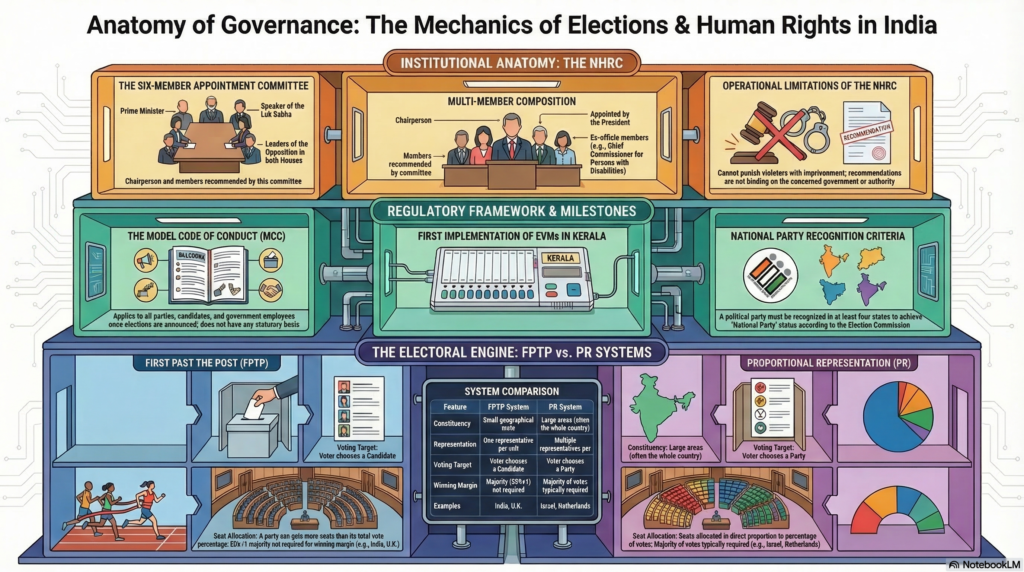
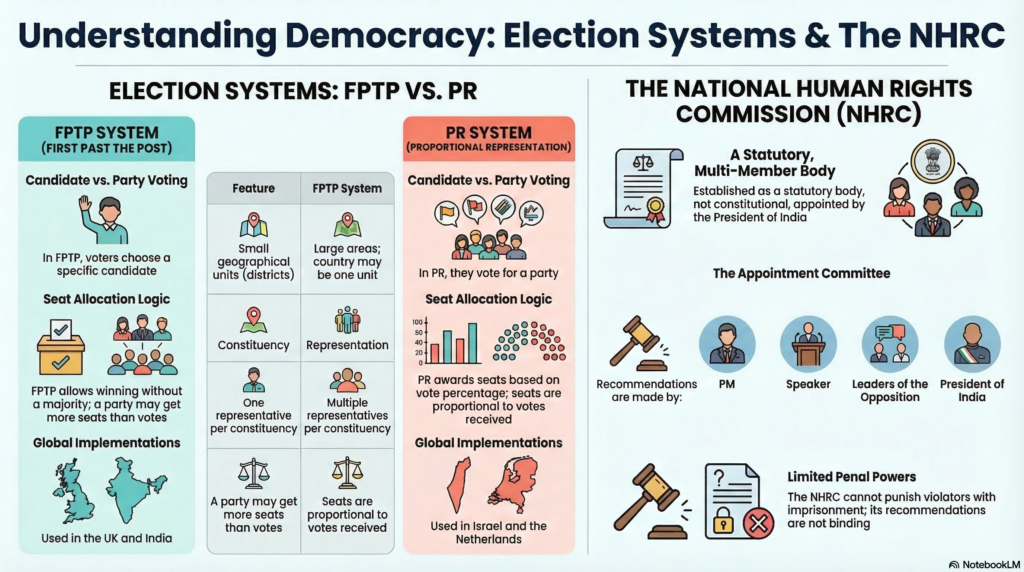
The Electoral System: First Past the Post (FPTP) -borrowed from Britain
India primarily uses the First Past the Post system for Lok Sabha and Assembly elections,
distinct from Proportional Representation (PR),. - How it works: The country is divided into small geographical units (constituencies).
- The Winner: Voters choose a candidate. The candidate with the highest number of votes is
declared elected. - Key Feature: A candidate does not need a majority (50% + 1) to win; they just need more votes
than anyone else. - Comparison: Unlike PR systems (like in Israel or Netherlands) where parties get seats
proportional to their vote share, in FPTP, a party may get more seats than their vote share
suggests. ——————————————————————————–
Political Parties: Recognition & Symbols
Political parties are voluntary groups aiming for political power. They must register with the ECI
under Section 29A of the RPA, 1951,.
Recognition Criteria (The “National” vs. “State” Status) - National Party Status (Must fulfill one of these):
- Secure 6% of valid votes in 4 or more states (in LS or Assembly elections) AND win 4 Lok
Sabha seats. From any state or states. - Win 2% of total Lok Sabha seats elected from at least 3 different states.
- Be recognized as a State Party in 4 states.
National Parties - AAP -Broom
- Bahujan Samaj Party – Elephant
- BJP -Lotus
- CPI(M) -Hammer , Sickel and star
- INC – Hand
- National peoples party – Book
- State Party Status (Must fulfill one of these),:
- 6% valid votes in the State Assembly election AND win 2 Assembly seats.
- 6% valid votes in the Lok Sabha election from that state AND win 1 Lok Sabha seat.
- Win 3% of total Assembly seats OR atleast 3 seats (whichever is more).
- Win 1 Lok Sabha seat for every 25 seats allotted to the state.
- Secure 8% of total valid votes in the state (added in 2011).
Symbols:
- National Parties: Have a unique symbol reserved exclusively for them across India.
- State Parties: Have symbols reserved for use within their specific state(s).
* Unrecognized Parties: Must choose freely from a list of available symbols.
The Tech: Electronic Voting Machines (EVMs)
Gone are the days of ballot papers; India now uses secure EVMs manufactured by ECIL
(Hyderabad) and BEL (Bangalore),.
How they work:
- Two Units: A Control Unit (with the Polling Officer) and a Balloting Unit (in the voting booth),
connected by a cable. - The Process: The officer presses the “Ballot” button on the Control Unit, activating the
Balloting Unit for one vote. The voter presses the blue button next to their choice. - Capacity: An EVM can record a maximum of 2,000 votes.
- Candidates: M3 version EVMs can handle up to 384 candidates by connecting 24 Balloting
Units. If candidates exceed this, traditional ballot papers are used. - Power: They run on ordinary battery packs, not grid electricity, making them usable anywhere.
History of EVM Adoption,: - 1982: First experimental use in Kerala (Parur Assembly Constituency).
- 1989: RPA, 1951 amended to legally allow EVMs.
- 1998: Used in elections in Rajasthan, MP, and Delhi.
- 2004: Historic decision to use EVMs for the entire Lok Sabha election. ——————————————————————————–
Trust & Verification: VVPAT
To ensure transparency, the Voter Verifiable Paper Audit Trail (VVPAT) was introduced,
bolstered by a 2013 Supreme Court ruling (Subramanian Swamy vs ECI). - What it is: An independent printer attached to the EVM.
- Verification: When you vote, a paper slip with the candidate’s name, symbol, and serial
number appears behind a glass window for 7 seconds. - The Trail: The slip automatically cuts and falls into a sealed drop box. It allows the voter to
verify their vote went to the right candidate. - First Use: Noksen Assembly Constituency, Nagaland (2013).
- Universal Use: Used in all constituencies during the 2019 Lok Sabha elections.
Not used in local body election ——————————————————————————–
The Moral Code: Model Code of Conduct (MCC)
The MCC is a set of guidelines for good behavior, evolved with the consensus of political parties. - Timeline: Comes into effect the moment the election schedule is announced and lasts until
the process is complete. - Legal Status: It is not legally enforceable by itself.
- Origins: First used in the Kerala State Assembly elections in 1960.
- Structure (7 Parts):
- General good behavior.
- Public meetings.
- Processions.
- Polling day behavior.
- Polling booths.
- Observers.
- Party in power. ——————————————————————————–
The Guardian: Independent Election Commission
To ensure free and fair elections, the ECI is an independent constitutional body.
- Composition: It can be a single or multi-member body. It became a multi-member body
permanently in 1993 and currently consists of the Chief Election Commissioner (CEC) and two
other Election Commissioners,. - Protection: The CEC can only be removed through a process similar to the impeachment of a
Supreme Court judge, ensuring they can work without political pressure. - Staff: The ECI has a small permanent staff but assumes control over central and state
government officials deployed for election duty during the election period. - State Level: In every state, a Chief Electoral Officer (CEO) assists the ECI. Note: The State
Election Commission is a separate body for local body elections (Panchayats/Municipalities),
distinct from the ECI.
PART 1: THE ELECTION MACHINERY
The rules and tools that power Indian Democracy.
- The System: First Past the Post (FPTP)
- The Method: India uses FPTP, not Proportional Representation (PR) for general elections.
- The Winner: The candidate with the highest votes wins. They do not need a majority (50% + 1).
- The Disparity: A party can win more seats than its vote share suggests (e.g., winning 80%
seats with 40% votes).
- The Watchdog: Election Commission of India (ECI)
- Power Source: Article 324 gives the ECI power of superintendence, direction, and control
over elections . - Scope: Covers Parliament, State Legislatures, President, and Vice-President elections .
- Electoral Rolls: The responsibility for preparing these lies solely with the ECI, not the
Parliament or Local Admin. - Independence: The ECI can exercise powers even without specific parliamentary laws to
ensure free elections (it acts as a reservoir of power) .
- The Rule Book: Representation of People Acts (RPA)
- RPA, 1950 (Preparation): Deals with Electoral Rolls and delimitation of constituencies .
- RPA, 1951 (Conduct): Deals with the actual conduct of elections,
qualifications/disqualifications of MPs/MLAs, and corrupt practices .
- Political Parties: Earning the Status
- Recognition: Granted by the ECI based on poll performance .
- National Party Criteria (Any one):
◦ Win 2% of Lok Sabha seats from at least 3 states .
◦ Secure 6% valid votes in 4 states + win 4 Lok Sabha seats .
◦ Be recognized as a State Party in 4 states . - Symbols: National parties have an exclusive symbol across India. State parties have
symbols reserved only in their specific states .
- Technology & Transparency
- EVMs: First used in Kerala (Parur constituency, 1982).
- VVPAT (Voter Verifiable Paper Audit Trail):
◦ Allows voters to verify their vote went to the intended candidate .
◦ The slip is visible for 7 seconds behind a glass window .
◦ First introduced in a by-election in 2013 (Noksen, Nagaland) .
- Model Code of Conduct (MCC)
- Timing: Comes into force immediately upon the announcement of the election schedule .
- Legal Status: It is not legally enforceable by itself (no statutory basis).
- History: First used in Kerala Assembly elections (1960) .
- Scope: Applies to parties, candidates, and the government in power (to prevent misuse of
official machinery).
- Delimitation Commission
- Authority: A statutory body; its orders have the force of law and cannot be challenged in any
court . - Frequency: Constituted 4 times so far (1952, 1963, 1973, 2002) . ——————————————————————————–
PART 2: HUMAN RIGHTS COMMISSIONS
The guardians of rights, defined and limited by the Protection of Human Rights Act, 1993.
- National Human Rights Commission (NHRC)
- Nature: It is a Statutory Body (created by Act of Parliament in 1993), not a Constitutional body
. - Standards: It acts in conformity with the Paris Principles regarding national human rights
institutions . - Definition of Rights: Protects rights guaranteed by the Constitution and International
Covenants enforceable by Indian courts .
- Appointment & Composition
- Appointed By: The President .
- Selection Committee (6 Members): Recommendations are made by a committee headed by
the Prime Minister. Members include:
◦ Speaker of Lok Sabha
◦ Deputy Chairman of Rajya Sabha
◦ Leaders of Opposition in both Lok Sabha & Rajya Sabha
◦ Union Home Minister .
◦ (Note: The Chief Justice of India is NOT on the committee, but consulted for appointing
sitting judges) . - Who leads it? The Chairperson must be a former Chief Justice of India or a Judge of the
Supreme Court . - Members: Includes serving/former SC judges and requires at least one woman expert
member . - Ex-Officio Members: Includes Chairpersons of National Commissions for SCs, STs, OBCs,
Minorities, Women, and the Chief Commissioner for Persons with Disabilities .
- Tenure & Removal
- Term: 3 years or until the age of 70 years (whichever is earlier) . (Note: It was previously 5
years, but amended). - Removal: By the President alone.
◦ Grounds: Proved misbehavior or incapacity (requires Supreme Court inquiry) [27, Slide
Q6].
◦ Exceptions: No inquiry needed for insolvency or holding an office of profit [Slide Q6].
- Powers & Limitations (The “Toothless Tiger”?):
- Time Limit: The NHRC can only investigate cases within one year of their occurrence .
- Advisory Only: Its recommendations are not binding on the government. It cannot punish
violators or award relief (imprisonment/fines) . - Court Powers: It has the powers of a Civil Court (can summon witnesses, request public
records) [28, Slide Q7]. - Custodial Deaths: The NHRC’s Investigation Division handles reports of custodial deaths,
which must be intimated within 24 hours [Slide Q7].
- State Human Rights Commission (SHRC)
- Jurisdiction: Can investigate matters in List II (State List) and List III (Concurrent List) .
- The Power Twist:
◦ Appointed by the Governor.
◦ BUT can only be removed by the President . - Limitation: Like the NHRC, it also has a 1-year limitation period for cases .
. Which of the following statements is correct with reference to the Model Code of Conduct
(MCC)? - (A) It does not come into force immediately.
- (B) It applies to all including government employees.
- (C) Andhra Pradesh was the first state to implement it.
- (D) The Code of Conduct does not have any statutory basis.
- According to the Election Commission of India, in order to be recognized as a ‘National
Party’, a political party must be present in:
- (1) At least two States
- (2) At least three States
- (3) At least four States
- (4) At least five States
- EVM or Electronic Voting Machine was used for the first time in which state?
- (A) Bihar
- (B) Kerala
- (C) Gujarat
- (D) Uttar Pradesh
- The responsibility of preparation of electoral rolls rests with:
- (A) The Parliament
- (B) The Local Administration
- (C) The Election Commission
- (D) The State Government
- With reference to the Election Process of India, consider the following statements:
- The Model Code of Conduct takes effect immediately after the Election Commission
announces the election schedule. - The official campaign for the election officially ends 72 hours before polling closes.
- Which of the statements given above is/are incorrect?
◦ (a) 1 only
◦ (b) 2 only (Correct implies statement 2 is the incorrect one; it ends 48 hours before)
◦ (c) Both 1 and 2
◦ (d) Neither 1 nor 2
- Which of the following statements are correct with reference to the conditions for
Recognized National Party status in India? - If it secures six percent of valid votes polled in any six or more states…
- If it wins ten percent of seats in the Lok Sabha from more than three states.
- If the party is recognized as a state party in four states.
- Select the correct answer:
◦ (a) 1 and 2 only
◦ (b) 3 only
◦ (c) 2 and 3 only
◦ (d) 1 and 3 only
- Consider the following statements with reference to the system of elections:
- In the First Past the Post System, voters vote for the political party, while in proportional
representation, they vote for a candidate. - In First Past the Post System every constituency elects one representative, while in
proportional representation, more than one candidate can be elected.
- Which of the statements given above is/are correct?
◦ (a) 1 only
◦ (b) 2 only
◦ (c) Both 1 and 2
◦ (d) Neither 1 nor 2
- With reference to Proportional Representation system, consider the following
statements: - The Indian Constitution adopted the system… only for Rajya Sabha and not for Lok Sabha.
- In proportional representation, every section of the population gets its due representation…
- Proportional representation… is used for election of RS, State Legislative Council and for
election of President, Vice-president and Governor.
- How many of the statements given above are correct?
◦ (a) Only one
◦ (b) Only two
◦ (c) All three
◦ (d) None
- Consider the following provisions:
- Registration of political parties.
- Notification of general elections.
- Electoral rolls for Parliamentary constituencies.
- How many of the above mentioned provisions are provided under the Representation of
the People Act, 1950?
◦ (a) Only one
◦ (b) Only two
◦ (c) All three
◦ (d) None
- The Representation of People’s Act, 1951 deals with which of the following provisions
of election? - Qualifications and disqualifications for membership…
- Conduct of elections.
- Delimitation of Parliamentary… Constituencies.
- Corrupt practices and Electoral offenses.
- Select the correct answer:
◦ (a) 1, 2 and 4 only
◦ (b) 2 and 3 only
◦ (c) 1 and 4 only
◦ (d) 1, 2, 3 and 4
- How many of the above are mentioned on the slip printed by the Voter Verifiable Paper
Audit Trail (VVPAT)? - Serial Number
- Name of the Candidate
- Symbol of the candidate
- Name of the Party candidate belongs to.
- Select the correct answer:
◦ (a) Only one
◦ (b) Only two
◦ (c) Only three
◦ (d) All four
- Consider the following statements regarding Delimitation Commission:
- It is a constitutional body established by the Central Government.
- Its orders have the force of law and cannot be challenged in any court.
- Four Delimitation Commissions have been constituted so far.
- How many of the statements given above are correct?
◦ (a) Only one
◦ (b) Only two
◦ (c) All three
◦ (d) None
- With reference to Article 324 of the Indian Constitution, consider the following
statements: - It vests the superintendence, direction and control of elections in the Election Commission of
India. - It applies only to elections to Parliament and State Legislatures.
- It also covers elections to the offices of President and Vice-President.
- Which of the statements given above are correct?
◦ (a) 1 and 2 only
◦ (b) 1 and 3 only
◦ (c) 2 and 3 only
◦ (d) 1, 2 and 3
- Consider the following statements regarding recognition of political parties in India:
- Recognition as National or State party is done by the Election Commission of India.
- All registered political parties are necessarily recognised parties.
- Recognition is based on poll performance in elections.
- Which of the statements given above are correct?
◦ (a) 1 and 3 only
◦ (b) 1 and 2 only
◦ (c) 2 and 3 only
◦ (d) 1, 2 and 3
- Which of the following conditions can lead to recognition of a State Party?
- Securing 8% of total valid votes in the state.
- Winning 3% of Assembly seats or 3 seats, whichever is more.
- Winning one Lok Sabha seat for every 25 seats allotted to the state.
- Select the correct answer:
◦ (a) 1 and 2 only
◦ (b) 2 and 3 only
◦ (c) 1 and 3 only
◦ (d) 1, 2 and 3
- With reference to Election Symbols, consider the following statements:
- A National Party has an exclusive symbol throughout India.
- A State Party’s symbol is valid only within the state(s) of recognition.
- Registered but unrecognised parties are allotted symbols compulsorily by ECI.
- Which of the statements given above are correct?
◦ (a) 1 and 2 only
◦ (b) 2 and 3 only
◦ (c) 1 and 3 only
◦ (d) 1, 2 and 3
- With reference to Voter Verifiable Paper Audit Trail (VVPAT), consider the following
statements: - It allows the voter to verify that the vote has gone to the intended candidate.
- The printed slip remains visible to the voter permanently.
- VVPAT was first introduced in a by-election in 2013.
- Which of the statements given above are correct?
◦ (a) 1 only
◦ (b) 1 and 3 only
◦ (c) 2 and 3 only
◦ (d) 1, 2 and 3
- Consider the following statements about the Model Code of Conduct (MCC):
- It comes into force from the date of announcement of election schedule.
- It is legally enforceable under the Representation of the People Act.
- It was first used in Kerala Assembly elections in 1960.
- Which of the statements given above are correct?
◦ (a) 1 and 3 only
◦ (b) 1 and 2 only
◦ (c) 2 and 3 only
◦ (d) 1, 2 and 3
- With reference to Article 324, consider the following statements:
- The Election Commission derives its powers only from Parliamentary law.
- Article 324 covers preparation of electoral rolls.
- The Election Commission has authority over elections to the office of Vice-President.
- Which of the statements given above are correct?
◦ (a) 2 and 3 only
◦ (b) 1 and 2 only
◦ (c) 3 only
◦ (d) 1, 2 and 3
- With reference to National Political Party status, consider the following statements:
- Securing 6% votes in four states alone is sufficient.
- Winning 2% Lok Sabha seats from at least three states is sufficient.
- Recognition as a State Party in four states is sufficient.
- Which of the statements given above are correct?
◦ (a) 1 and 2 only
◦ (b) 2 and 3 only
◦ (c) 3 only
◦ (d) 1, 2 and 3
- With reference to the Election Commission of India, consider the following statements:
- The powers of the Election Commission are derived exclusively from the Representation of
the People Acts. - Article 324 acts as a reservoir of powers for the Election Commission.
- The Election Commission can exercise powers even in the absence of specific parliamentary
law.
- Which of the statements given above are correct?
◦ (a) 2 and 3 only
◦ (b) 1 and 2 only
◦ (c) 1 and 3 only
◦ (d) 1, 2 and 3 ——————————————————————————–
Topic: Human Rights Commissions (NHRC/SHRC)
- Consider the following statements with respect to National Human Rights
Commission: - It can investigate human rights violations within one year of their occurrence.
- The service conditions of its chairperson are determined by the Parliament.
- It can investigate cases of human rights violations by private parties as well.
- Which of the statements given above are incorrect?
◦ (a) 1 and 2 only
◦ (b) 2 and 3 only
◦ (c) 1 and 3 only
◦ (d) All of the above
- Consider the following statements regarding the National Human Rights Commission:
- It is a multi-member body appointed by the President of India.
- The Chief Commissioner for Persons with Disabilities is an ex-officio member of the NHRC.
- Which of the statements given above are correct?
◦ (a) 1 only
◦ (b) 2 only
◦ (c) Both 1 and 2
◦ (d) Neither 1 nor 2
- Consider the following statements regarding the National Human Rights Commission
(NHRC): - NHRC is a constitutional body…
- NHRC does not have the power to punish violators…
- NHRC can inquire into violations… regardless of when the violation occurred.
- NHRC’s recommendations are binding…
- Which of the statements given above is/are correct?
◦ (a) 1 and 2 only
◦ (b) 3 and 4 only
◦ (c) 2 only
◦ (d) 1, 2, and 3 only
- Who among the following are the members of the committee on whose
recommendation the chairperson and members of National Human Rights Commission
are appointed? - Prime Minister
- Speaker of the Lok Sabha
- Leaders of the Opposition in both the Houses of Parliament
- Chairman of the Rajya Sabha
- Chief Justice of India
- Select the correct answer:
◦ (a) 1, 2, and 3 only
◦ (b) 1, 2, 3 and 4 only
◦ (c) 3, 4 and 5 only
◦ (d) 1, 2, 3, 4 and 5
- Consider the following statements regarding the National Human Rights Commission
(NHRC): - The Central Finance Minister is a part of the six-member committee…
- The appointment of a sitting judge of the Supreme Court to the NHRC requires consultation
with the Chief Justice of India.
- Which of the statements given above is/are correct?
◦ (a) 1 only
◦ (b) 2 only
◦ (c) Both 1 and 2
◦ (d) Neither 1 nor 2
- Consider the following statements regarding National Human Rights Commission:
- The chairperson and members of the commission hold office for a term of five years or until
they attain the age of 65 years. - The President can remove the chairperson or any member of the commission on the ground
of proved misbehaviour or incapacity.
- Which of the statements given above is/are correct?
◦ (a) 1 only
◦ (b) 2 only
◦ (c) Both 1 and 2
◦ (d) Neither 1 nor 2
- Consider the following statements regarding the State Human Rights Commission
(SHRC): - It can inquire into any matter after the expiry of one year.
- It can call for reports from the State Government.
- It has all the powers of a civil court…
- How many of the statements given above are correct?
◦ (a) Only one
◦ (b) Only two
◦ (c) All three
◦ (d) None
- Consider the following statements regarding State Human Rights Commission:
- It can investigate only those cases that are related to subjects mentioned in the List II…
- All the members of the Commission are appointed by the President.
- The Chairman… can be appointed only after consultation with the Chief justice of the
concerned state High Court.
- How many of the statements given above are correct?
◦ (a) Only one
◦ (b) Only two
◦ (c) All three
◦ (d) None
- In the context of the State Human Rights Commission in India, consider the following
statements: - The members can be removed by the Governor but the Chairperson can only be removed by
the President. - The commission has the power of a civil court.
- There is a limitation of two years to enquire into cases…
- How many of the statements given above is/are correct?
◦ (a) Only one
◦ (b) Only two
◦ (c) All three
◦ (d) None
- With reference to the appointment of NHRC members, consider the following
statements: - The President appoints members on the recommendation of a committee chaired by the
Prime Minister. - The Leader of Opposition of only Lok Sabha is a member of the committee.
- The Deputy Chairman of Rajya Sabha is part of the committee.
- Which of the statements given above is/are correct?
◦ (a) 1 and 3 only
◦ (b) 1 only
◦ (c) 2 and 3 only
◦ (d) 1, 2 and 3
- Consider the following statements regarding removal of NHRC members:
- Removal is by the President on grounds of proved misbehaviour or incapacity.
- Supreme Court conducts inquiry before removal.
- Insolvency requires Supreme Court inquiry.
- Which of the above statements is/are correct?
◦ (a) 1 and 2 only
◦ (b) 1 and 3 only
◦ (c) 2 and 3 only
◦ (d) 1, 2 and 3
- Which of the following divisions of NHRC is primarily responsible for custodial death
intimation within 24 hours?
- (a) Law Division
- (b) Training Division
- (c) Investigation Division
- (d) PRP & Programmes Division
- Consider the following statements regarding the definition of “Human Rights” under
the Protection of Human Rights Act, 1993: - Human rights include rights guaranteed by the Constitution of India.
- Rights embodied in International Covenants are included only if they are enforceable by
courts in India.
- Which of the statements given above is/are correct?
◦ (a) 1 only
◦ (b) 2 only
◦ (c) Both 1 and 2
◦ (d) Neither 1 nor 2
- With reference to the composition of NHRC, consider the following statements:
- The Chairperson must be a former Chief Justice of India only.
- One member must be a serving or former Judge of the Supreme Court.
- At least one expert member must be a woman.
- Which of the statements given above is/are correct?
◦ (a) 2 and 3 only
◦ (b) 1 and 2 only
◦ (c) 3 only
◦ (d) 1, 2 and 3
- Consider the following statements regarding the tenure of NHRC members:
- The tenure is five years or until 70 years of age…
- The tenure was reduced by amendment.
- Chairperson and members have the same tenure conditions.
- Which of the statements given above is/are correct?
◦ (a) 2 and 3 only
◦ (b) 1 and 2 only
◦ (c) 3 only
◦ (d) 1, 2 and 3
- With reference to the removal of NHRC members, consider the following statements:
- Removal on grounds of misbehaviour requires Supreme Court inquiry.
- Insolvency requires reference to Supreme Court.
- Engaging in office of profit can lead to removal without Supreme Court inquiry.
- Which of the statements given above is/are correct?
◦ (a) 1 only
◦ (b) 1 and 3 only
◦ (c) 2 and 3 only
◦ (d) 1, 2 and 3
- Consider the following statements regarding powers of NHRC:
- NHRC has powers of a civil court during inquiry.
- NHRC can issue binding judgments.
- NHRC can summon witnesses and requisition public records.
- Which of the statements given above is/are correct?
◦ (a) 1 and 3 only
◦ (b) 1 only
◦ (c) 2 and 3 only
◦ (d) 1, 2 and 3
- Consider the following statements regarding ex-officio members of NHRC:
- All ex-officio members are heads of constitutional bodies.
- Chairperson of National Commission for Backward Classes is an ex-officio member.
- Chief Commissioner for Persons with Disabilities is an ex-officio member.
- Which of the statements given above is/are correct?
◦ (a) 2 and 3 only
◦ (b) 1 and 2 only
◦ (c) 3 only
◦ (d) 1, 2 and 3
- With reference to NHRC and international human rights standards, consider the
following statements: - NHRC is aligned with the Paris Principles…
- NHRC derives its powers directly from international covenants ratified by India.
- NHRC can review India’s compliance with international human rights obligations.
- Which of the statements given above is/are correct?
◦ (a) 1 and 3 only
◦ (b) 1 only
◦ (c) 2 and 3 only
◦ (d) 1, 2 and 3