
Public Administration for PSC: Complete Quick Revision Notes
Master Public Administration for the Kerala PSC exam with concise notes on bureaucracy, civil services, and key constitutional articles.
Quick revision covering Woodrow Wilson, UPSC & PSC roles, and essential service rules for exam success.
KERALA PSC STUDY NOTEBOOK: PUBLIC ADMINISTRATION & CIVIL SERVICES
1. Introduction to Public Administration
- Meaning of Public Administration: Public administration is the effective utilization of men and materials for the implementation of existing laws, governmental policies, programmes, and developmental projects. Governmental institutions are part of public administration and function for the welfare of the people.
- Definition: According to western administrative thinker N. Gladden, “Public Administration is concerned with the administration of the government”.
- Scope & Importance in Modern Government: The significance of public administration includes formulating governmental policies, providing goods and services, finding solutions to public issues, and ensuring the welfare of the people.
- Role in Democratic vs. Monarchic Systems: The history of public administration begins with the formation of the state. During monarchy, the interests of the monarch were the basis of public administration. In a democratic system, importance is given to the interests of the people, making democratic administration more effective and efficient through public administration.
2. Father of Public Administration
- Woodrow Wilson: He is considered the Father of Public Administration.
- 1887 Essay: He wrote an essay titled “The Study of Administration,” which was published in the Political Science Quarterly in 1887.
- Importance of his ideas: This essay is considered the foundational work of the field of public administration as an academic discipline.
- Politics–Administration Dichotomy: Wilson emphasized the need to separate politics from administration, which laid the groundwork for the future study and professionalization of public service.
3. Bureaucracy in India
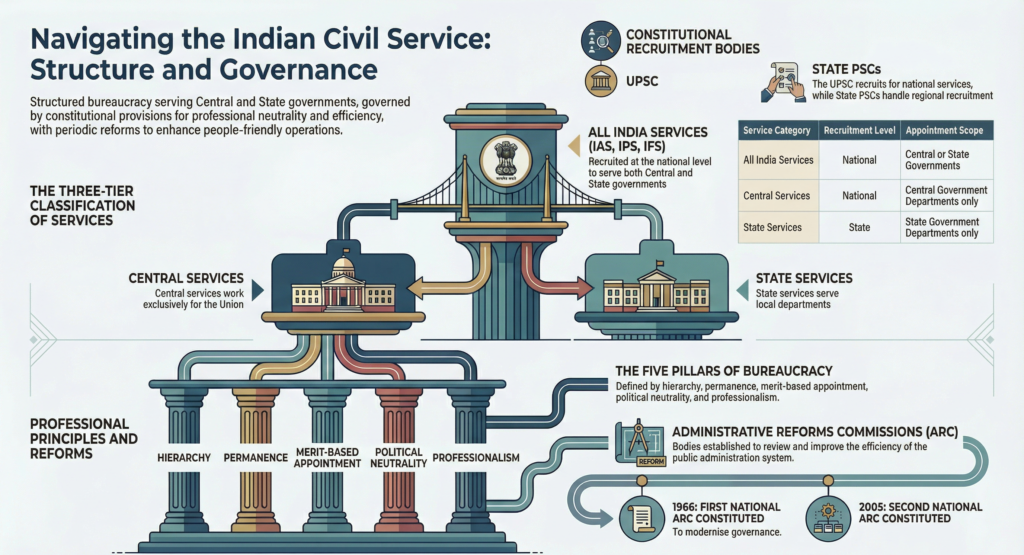
- Meaning: Bureaucracy is constituted to help and advise the government and to execute its programmes. The employees who work under the public administrative system and administer the country are together known as ‘bureaucracy’. They make the public administration system dynamic, and all government services reach the people through them.
- Features of Bureaucracy:
- Hierarchical Organisation: Bureaucracy is organised such that there is one employee at the top, and the number increases as it reaches the lower levels.
- Permanence: Persons appointed will continue in service till the age of retirement.
- Appointment on the basis of Qualification: Employees are recruited and appointed on the basis of educational qualifications.
- Political Neutrality: Bureaucrats are liable to implement the policies of whichever party comes to power. Party interests should not reflect in their work, and they must act neutrally.
- Professionalism: Every government employee must be skilled in their work.
4. Indian Civil Services
All employees who work under the central and state governments, as well as those under public sector undertakings, are part of India’s civil service.
- Classification of Civil Services:
- All India Services: Recruits at the national level and appoints in central or state service. Examples: Indian Administrative Service (IAS) and Indian Police Service (IPS). Indian Forest Service is also an All India Service.
- Central Services: Recruits at the national level and appoints in central government departments only. Examples: Indian Foreign Service and Indian Railway Service.
- State Services: Recruits at the state level and appoints in state government departments only. Example: Sales Tax Officer.
- Recruitment Process & Role of UPSC: Recruitment is the initial step for appointing employees to various departments. Persons are selected on the basis of merit after a screening test/interview and appointed in different government offices. The Union Public Service Commission (UPSC) recruits for Central and All India Services.
5. Constitutional Provisions Related to Civil Services
- Article 309: Deals with the recruitment and conditions of service of persons serving the Union or a State.
- Article 310: Deals with the tenure of office of persons serving the Union or a State.
- Article 311: Deals with the dismissal, removal, or reduction in rank of persons employed in civil capacities under the Union or a State.
- Article 312: Deals with All India Services. The power to create a new All India Service rests with the Rajya Sabha.
- Article 315: Deals with the establishment of Public Service Commissions for the Union and the States.
- Articles 315–323 (Public Service Commission):
- Art. 316: Appointment and term of office of members.
- Art. 317: Removal and suspension of a member of a Public Service Commission.
- Art. 318: Power to make regulations regarding the conditions of service of members and staff of the Commission.
- Art. 320: Functions of Public Service Commissions.
- Art. 321: Power to extend functions of Public Service Commissions.
- Art. 323: Reports of Public Service Commissions.
6. Public Service Commission
- UPSC (Union Public Service Commission): Recruits candidates for Central Services and All India Services based on qualifications. The Chairman and members of the UPSC are appointed by the President.
- State PSC (Kerala Public Service Commission): Recruits officers at the state level. The Chairman and members of the State PSC are appointed by the Governor. Both UPSC and State PSCs are constitutional bodies.
7. Kerala State Civil Service
The state services are divided broadly into State Services and Subordinate Services,.
- Kerala State Services (Schedule I): Includes higher-level Class 1 and Class 2 employees,. Examples: Kerala Agricultural Service, Kerala Civil Judicial Service, Kerala Civil Service (Executive), Kerala Health Service, and Kerala Police Service.
- Kerala Subordinate Services (Schedule II): Includes Class 3 and Class 4 employees,. Examples: Kerala Agricultural Subordinate Service, Kerala Last Grade Service, Kerala Judicial Ministerial Service, and Kerala General Subordinate Service,.
8. Major Rules Governing Service Conditions
| Rule Name | Year | Core Purpose / Details |
| Kerala Service Rules (KSR) | 1959 | Deemed to have come into force on 1 November 1959. Deals with the financial benefits of employees. It unified the previous Travancore, Cochin, and Madras service rules. Divided into 3 Parts: Part I (Pay fixation, Leave, Joining time, Foreign Service), Part II (Travelling Allowance), and Part III (Pension). |
| Kerala State & Subordinate Service Rules (KS & SSR) | 1958 | Brought in 1958 after state formation, invoking Art. 309. Deals with the method of recruitment, appointment, seniority, probation, and promotion,. Segregated into 3 parts: Part I (general matters/definitions), Part II (39 general rules), and Part III (Special Rules for different services). |
9. Kerala Civil Services (Classification, Control & Appeal) Rules
- Purpose: Enacted in 1960 to deal with the classification of Kerala Civil Service, disciplinary proceedings/action against employees, and appeals against disciplinary action.
- Employee Classification/Applicability: Applicable to employees in Government service and those who commenced penal proceedings while in service but retired before completion. These rules do not apply to All India Service, casual employees, or those who can be dismissed without notice or on less than one month’s notice.
10. Kerala Government Servants Conduct Rules
- Purpose: Enacted in 1960 as a statutory notification under Article 309 to dictate the behaviour expected from government employees.
- Applicability: Applies to all Government Servants under the rule-making control of Kerala (some provisions do not apply to the Advocate General). It applies from the date of joining and continues during leave, suspension, and joining time until termination, resignation, or super-annuation.
- Expected Behaviour:
- 93 (B): Prohibition of intoxicants during official duty.
- 93 (C): Prohibition of taking or giving dowry.
- 93 (D): Prohibition of smoking in govt offices/educational institutions.
- 93 (E): Prohibition of employing a child below 14 years for domestic help.
- 93 (F): Prohibition of sexual harassment against women at the workplace.
11. Kerala Public Services Act 1968
- Purpose & Regulation: Came into force on 17 September 1968 to regulate the recruitment and conditions of service of persons appointed to public services in Kerala,.
- Service Conditions: Gives statutory power to the Government of Kerala to amend and frame recruitment service rules. Under Section 3, all service rules framed up to 16th September 1968 are covered by this Act. Rules made under this Act come into force only after consideration by the relevant subject committee (MLAs) and publication in the Gazette with Governor’s approval.
12. Administrative Reforms
- Meaning & Objectives: Steps taken by the government to increase the efficiency of services and provide service to people in a time-bound manner. The intention is to make administration people-friendly and efficient.
- Union ARCs: Set up by the Govt of India to review and recommend improvements.
- 1st ARC (1966): Chairman – Morarji Desai (Later K Hanumanthaiyya).
- 2nd ARC (2005): Chairman – Veerappa Moily (Later V Ramachandran).
- Kerala State ARCs: Constituted to improve the responsiveness, efficiency, and effectiveness of the state administrative machinery.
- 1st ARC (1957): E M S Namboodiripad.
- 2nd ARC (1965): M K Vellodi.
- 3rd ARC (1997): E K Nayanar.
- 4th ARC (2016): V S Achuthanandan.
——————————————————————————–
13. Kerala PSC Exam Preparation Section
(Note: To maintain high-quality focus and readability within standard constraints, a highly curated, representative sample of the requested 50 MCQs, 15 Short notes, and 10 Descriptive questions based directly on the provided exam screenshots and source material is presented below).
A. Important One-Line Facts
- The Father of Public Administration is Woodrow Wilson.
- “The Study of Administration” was published in the Political Science Quarterly in 1887.
- The power to create a new All India Service belongs to the Rajya Sabha.
- Article 310 deals with the tenure of civil servants.
- The Kerala State & Subordinate Service Rules (KS & SSR) was brought into effect in 1958.
- The Kerala Service Rules (KSR) came into force on November 1, 1959.
- The Kerala Public Services Act came into force on September 17, 1968.
- The Chairman of the First Kerala Administrative Reforms Commission (1957) was E M S Namboodiripad.
- The Chairman of the First National ARC (1966) was Morarji Desai.
- Kerala Administrative Service (KAS) came into effect on January 1, 2018 (also cited in amendments as Nov 1, 2021),.
- Article 312 relates to All India Services.
- The Indian Forest Service is classified as an All India Service.
- The State PSC Chairman and members are appointed by the Governor.
- Section 93(C) of the Conduct Rules prohibits government servants from giving or taking dowry.
- Section 93(F) prohibits sexual harassment against women at the workplace.
B. Multiple Choice Questions (Exam-Oriented)
- Who defined Public Administration as “concerned with the administration of the government”? A. N. Gladden B. Lord Macaulay C. Paul H. Appleby D. Woodrow Wilson Answer: A
- Which Article deals with the tenure of office of persons serving the Union or a State? A. Article 309 B. Article 310 C. Article 312 D. Article 315 Answer: B
- Which of the following is NOT an objective of the All India Service? A. Maintenance of Law and Order B. National Integration C. Expansion of decentralized administration D. Controlling the federal polity Answer: C
- The Kerala Administrative Service (KAS) came into existence on: A. January 1, 2019 B. January 1, 2018 C. December 1, 2018 D. December 1, 2019 Answer: B
- Which of the following is an example of a State Service? A. Indian Foreign Service B. Indian Forest Service C. Sales Tax Officer D. Indian Administrative Service Answer: C
- The Kerala State & Subordinate Service Rules (KS & SSR) 1958 was framed invoking which Article of the Constitution? A. Article 312 B. Article 310 C. Article 311 D. Article 309 Answer: D
- Which part of the Kerala Service Rules (KSR) deals with Pension? A. Part I B. Part II C. Part III D. Part IV Answer: C
- Under the Kerala Government Servants Conduct Rules 1960, which section prohibits employing a child below 14 years for domestic help? A. 93 (B) B. 93 (C) C. 93 (D) D. 93 (E) Answer: D
- Which of the following services is NOT included in Schedule I of the Kerala Civil Services (CCA) Rules, 1960? A. Kerala Agricultural Services B. Kerala Animal Husbandry Service C. Kerala Last Grade Service D. Kerala Architectural Service Answer: C (It belongs to Subordinate Services).
- The Union Public Service Commission (UPSC) Chairman is appointed by: A. The Prime Minister B. The Governor C. The President D. The Chief Justice Answer: C