
Preamble of the Indian Constitution
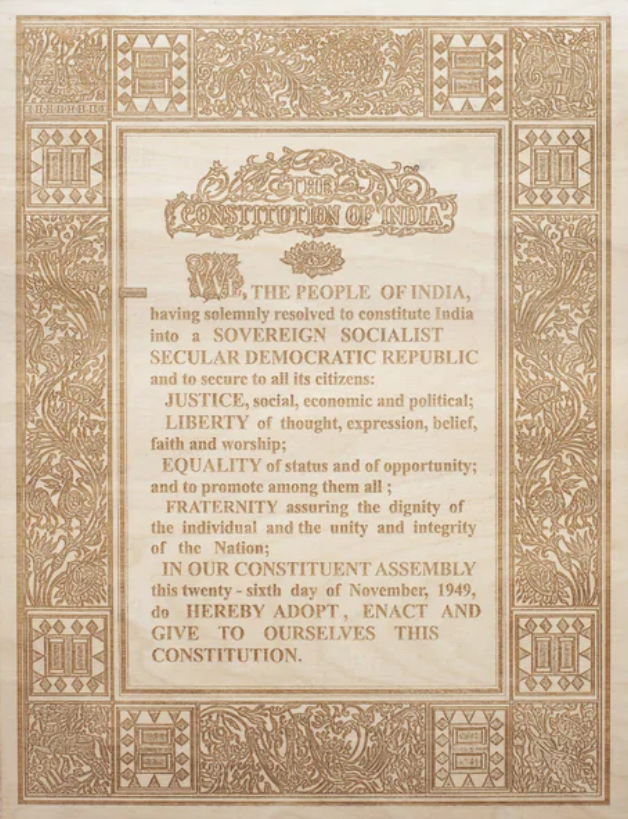
The Preamble of the Constitution of India is the introductory statement that outlines the core values and objectives of the Indian Constitution. It declares India as a Sovereign, Socialist, Secular, Democratic Republic and ensures Justice, Liberty, Equality, and Fraternity for all citizens. Adopted on November 26, 1949, the Preamble reflects the ideals and vision of the Constitution makers under the leadership of B. R. Ambedkar and the Constituent Assembly of India. It serves as the guiding principle for interpreting the Constitution and plays an important role in Kerala PSC and other competitive exams
UPSC Polity Notes: Preamble of the Indian Constitution
1. Introduction to the Preamble
• Meaning: The Preamble is an introductory statement that sets out the guiding purpose, principles, and philosophy of the Indian Constitution. It is often referred to as the “soul” and “spirit” of the Constitution.
• Inspiration: The practice of beginning a Constitution with a Preamble was borrowed from the American Constitution.
• Historical Background: It is based on the ‘Objectives Resolution’ drafted and moved by Pandit Jawaharlal Nehru on December 13, 1946, and adopted by the Constituent Assembly on January 22, 1947.
• Quotes by Experts:
◦ N.A. Palkhivala called it the “identity card of the Constitution”.
◦ K.M. Munshi called it the “horoscope of our sovereign democratic republic”.
◦ Pandit Thakurdas Bhargava called it the “soul of the Constitution”.
2. Four Ingredients/Components of the Preamble The Preamble reveals four essential components about the Indian State:
• Source of Authority: The phrase “We, the People of India” indicates that the Constitution derives its ultimate authority and sovereignty from the people of India.
• Nature of Indian State: It declares India to be a Sovereign, Socialist, Secular, Democratic, and Republic polity.
• Objectives of the Constitution: It specifies Justice, Liberty, Equality, and Fraternity as the primary objectives.
• Date of Adoption: It stipulates November 26, 1949, as the date the Constitution was adopted and enacted. (It came into full effect on January 26, 1950).
3. Key Words in the Preamble
• Sovereign: India is an independent state, neither a dependency nor a dominion of any other nation. It is free to conduct its own internal and external affairs. Membership in the UN or the Commonwealth does not limit this sovereignty.
• Socialist: Added by the 42nd Amendment Act (1976). India follows “democratic socialism” (a mixed economy where public and private sectors coexist), unlike communistic/state socialism. Its aim is to end poverty, disease, and inequality of opportunity.
• Secular: Added by the 42nd Amendment Act (1976). It embodies the positive concept of secularism (Sarva Dharma Sambhava), meaning the State has no official religion, and all religions receive equal status and support from the State. The Supreme Court in the S.R. Bommai case (1994) held that secularism is a basic feature of the Constitution.
• Democratic: India has a representative parliamentary democracy based on popular sovereignty, universal adult franchise, periodic elections, and rule of law. Dr. B.R. Ambedkar emphasized that political democracy must be backed by “social and economic democracy”.
• Republic: The head of the state (the President) is indirectly elected for a fixed period (five years), rather than being a hereditary monarch. It also denotes that political sovereignty vests in the people, and all public offices are open to citizens without discrimination.
• Justice (Social, Economic, and Political): The ideal of justice is borrowed from the Russian Revolution (1917). It seeks to eliminate discrimination based on caste, colour, or sex (Social), remove glaring wealth inequalities (Economic), and ensure equal access to political offices (Political).
• Liberty: Liberty of thought, expression, belief, faith, and worship. It is not absolute but ‘qualified’, meaning it is subject to reasonable restrictions mentioned in the Constitution. The ideals of Liberty, Equality, and Fraternity are borrowed from the French Revolution.
• Equality: Absence of special privileges for any section. The Preamble secures equality of status and opportunity, spanning civic (Articles 14-18), political (Articles 325-326), and economic (Article 39) dimensions.
• Fraternity: A sense of brotherhood promoted through single citizenship. It assures two things: the dignity of the individual and the unity and integrity of the Nation. The word ‘integrity’ was added by the 42nd Amendment Act (1976).
4. Is the Preamble a Part of the Constitution? This has been heavily debated and settled through key Supreme Court judgments:
• Berubari Union Case (1960): The Supreme Court stated that the Preamble is NOT a part of the Constitution and holds no substantive power, though it can act as a guiding tool to interpret ambiguous constitutional provisions.
• Kesavananda Bharati Case (1973): Overruling its previous judgment, the 13-judge bench held that the Preamble IS a part of the Constitution. It contains the basic structure and philosophy of the Constitution.
• Union Government vs. LIC of India Case (1995): The Supreme Court reaffirmed that the Preamble is an integral part of the Constitution.
5. Amendability of the Preamble
• In the Kesavananda Bharati case (1973), the Supreme Court held that the Preamble can be amended under Article 368, provided the amendment does not destroy the “Basic Structure” of the Constitution.
• It has been amended only once so far, by the 42nd Constitutional Amendment Act, 1976 (during the Emergency).
• The amendment added three new words: “Socialist”, “Secular”, and “Integrity”.
• Current Update (2024): The Supreme Court dismissed writ petitions challenging the retrospective insertion of the words ‘socialist’ and ‘secular’ in 1976, reaffirming that Parliament has the unquestionable power to amend the Preamble under Article 368.
6. Enforceability and Legal Status
• Non-Justiciable: The Preamble is non-justiciable; its provisions cannot be enforced in a court of law.
• Not a Source of Power: The Preamble is neither a source of substantive power to the legislature nor a prohibition or limitation upon the powers of the legislature.
• Interpretative Value: It acts as a valuable aid in the construction and interpretation of constitutional provisions and statutes (Charan Lal Sahu vs. Union of India).