
The Rowlatt Act of 1919
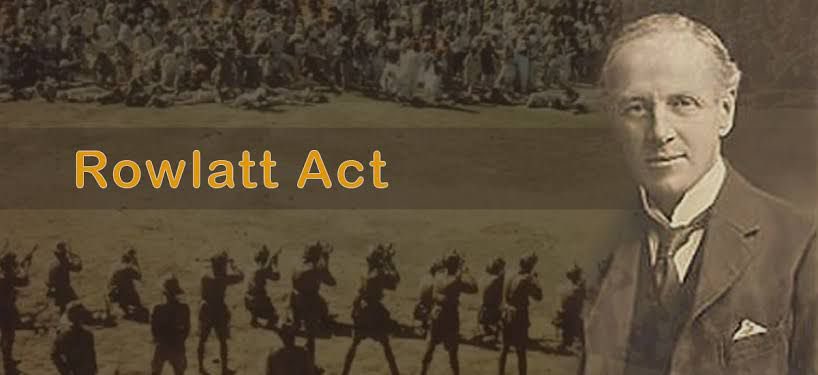
The Rowlatt Act of 1919, officially titled the Anarchical and Revolutionary Crimes Act, was a repressive piece of legislation that played a decisive role in radicalizing the Indian national movement.

1. Background and Origin
- Sedition Committee: The Act was based on the recommendations of the Sedition Committee (1917) chaired by Sir Sidney Rowlatt, a British judge.
- Extension of Wartime Powers: It was designed to replace the temporary Defence of India Act (1915) with a permanent statute to suppress the rising nationalist upsurge after World War I.
- Passing: It was hurriedly passed on March 18, 1919, by the Imperial Legislative Council in Delhi, despite the unanimous opposition of every Indian member.
2. Draconian Provisions (The “Black Act”)
- Detention Without Trial: Authorized the government to imprison individuals suspected of “revolutionary activities” for up to two years without charge or trial.
- Suspension of Habeas Corpus: Effectively suspended the right to a judicial review of detention.
- Special Tribunals: Allowed trials to be conducted in secrecy (in-camera) by a panel of three High Court judges without a jury.
- No Right to Appeal: Decisions of the special tribunals were final, with no provision for legal counsel or appeals to higher courts.
- Police Powers: Granted police the authority to search premises and arrest suspects without a warrant.
- Indian Slogan: The Act was summarized by the popular phrase: “Na Vakil, Na Dalil, Na Appeal” (No Lawyer, No Argument, No Appeal).
3. National Response: Rowlatt Satyagraha
- Satyagraha Sabha: Mahatma Gandhi founded the Satyagraha Sabha in February 1919 in Bombay to organize a nationwide protest.
- Nationwide Hartal: Gandhi called for a countrywide hartal (strike), fasting, and prayer on April 6, 1919.
- Mass Mobilization: This was Gandhi’s first all-India political movement, transforming the struggle for freedom from an elite-led movement into a mass-based one.
4. Impact and Consequence
- Jallianwala Bagh Massacre: The arrest of leaders Dr. Satyapal and Dr. Saifuddin Kitchlew in Amritsar under this Act led to protests that culminated in the Jallianwala Bagh massacre on April 13, 1919.
- Resignations in Protest:
- Mohammad Ali Jinnah, Madan Mohan Malaviya, and Mazhar-ul-Haq resigned from the Imperial Legislative Council.
- Sir C. Sankaran Nair (a Malayali jurist) resigned from the Viceroy’s Executive Council in July 1919 following the Punjab atrocities.
- Repeal: The Act was formally repealed in March 1922 based on the recommendations of the Repressive Laws Committee.
5. Specific Context
- Sir C. Sankaran Nair: Born in Palakkad, he was the only Malayali to serve as INC President (1897) and gained national fame for resigning his seat on the Viceroy’s Council to protest the Jallianwala Bagh incident.
- Manjeri Conference (1920): This conference linked the demand for the repeal of the Rowlatt Act with the Khilafat Movement and Malabar tenancy reforms, creating the populist energy that led to the 1921 Malabar Rebellion.
- Leaders: Key regional figures who organized the Rowlatt Satyagraha in Malabar included K.P. Kesava Menon and K. Madhavan Nair.