
Constituent Assembly of India – Complete PSC Revision Notes
Learn how the Constituent Assembly drafted the Indian Constitution with clear notes on its formation, members, committees, and key historical events.
A concise Kerala PSC revision guide covering the Cabinet Mission Plan, drafting process, and important dates from 1946–1950.
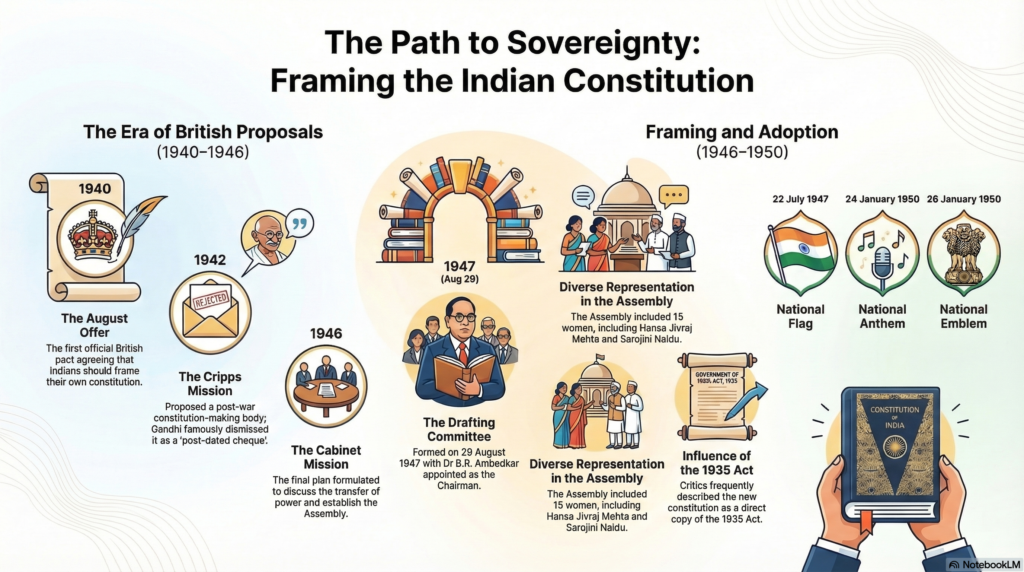
1️⃣ Background of the Constituent Assembly
- Early demands for a constitution-making body: The idea of an independent Constitution for India was first proposed by M. N. Roy through the newspaper Indian Patriot. He expressed this demand mainly through his writings, speeches, and articles in his journal Independent India.
- Role of the Swaraj Party: The Swaraj Party was the first political party to put forward the demand to form a Constituent Assembly for drafting the Constitution.
- Importance of the Nehru Report (1928): The Nehru Report marked India’s first comprehensive and indigenous attempt at framing a constitutional draft.
2️⃣ British Proposals Related to Constitution Making
- August Offer (1940)
- Announcement: It was announced by Viceroy Lord Linlithgow on August 8, 1940, as Britain’s first major attempt during World War II to secure Indian cooperation.
- Promise of Dominion Status: It promised Dominion Status after the war, meaning India would remain in the British Commonwealth but govern itself,.
- Proposal for a constitution-making body: It proposed setting up a Constitution-making body after the war where Indians would play a greater role,.
- Reactions: The Indian National Congress rejected the offer, demanding complete independence rather than just Dominion Status,. Jawaharlal Nehru remarked that the dominion status concept was “as dead as a door nail”. The Muslim League welcomed it because it recognized minority consent rights, which they felt strengthened their demand for separate nationhood,.
- Cabinet Mission Plan (1946)
- Objective: The main aim was to help Indians frame their own constitution and to secure an agreement with the leaders of all major Indian political parties.
- Federal structure proposed: India would remain united with a federal-type structure, and the demand for a separate Pakistan was rejected.
- Powers of the Union government: The Union Government would control only Defense, Foreign Affairs, and Communications.
- Role of provinces and princely states: All other powers were left to the provinces, and Princely States were free to choose whether to join the Union.
- Reactions: Congress accepted the idea of the Constituent Assembly but opposed the grouping of provinces. The Muslim League initially accepted it but later rejected it when Congress opposed grouping, leading them to launch Direct Action Day for a separate Pakistan,.
3️⃣ Formation of the Constituent Assembly
- Election method: The Constituent Assembly was formed using an indirect election method,.
- Proportional representation: Members of each community in the provincial legislative assemblies elected their representatives through proportional representation by means of the Single Transferable Vote,.
- Seat distribution based on population: Seats were allocated in proportion to their population, with an approximate ratio of 1 seat for every 1,000,000 (10 lakh) people,.
- Representation of communities: In each province, seats were proportionally distributed among three main communities: Muslims, Sikhs, and the General category (which included Hindus, Parsis, Anglo-Indians, etc.),.
4️⃣ Composition of the Constituent Assembly
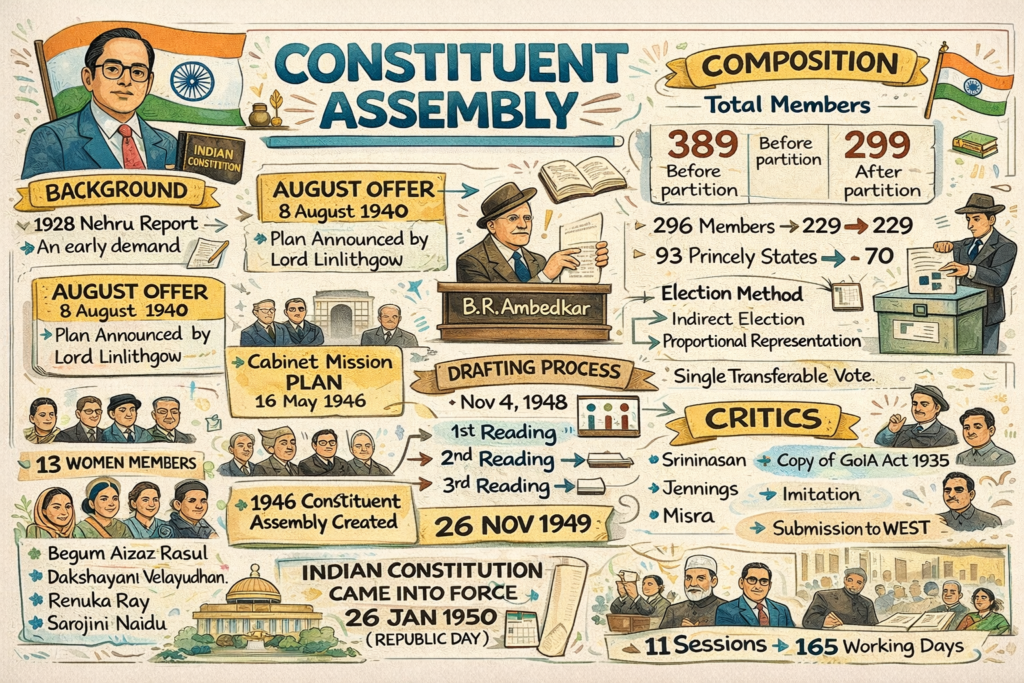
| Phase | Total Members | Members from British Provinces | Members from Princely States |
| Before partition | 389 | 296 | 93 |
| After partition | 299 | 229 | 70 |
5️⃣ Women Members of the Constituent Assembly
There was a total of 17 women in the Assembly (15 after partition).
- Begum Aizaz Rasul: Represented the United Provinces and was the only Muslim woman in the Constituent Assembly.
- Durgabai Deshmukh: Represented Madras Province and later served as a member of the Planning Commission of India.
- Hansa Jivraj Mehta: Represented Bombay Province. She famously changed the Universal Declaration of Human Rights draft phrase from “All men are born free” to “All human beings are born free and equal” as India’s UN delegate.
- Renuka Ray: Served as a member.
- Sarojini Naidu: Represented the United Provinces. Known as the “Nightingale of India,” she became the first Indian woman to become a state Governor.
- Vijaya Lakshmi Pandit: Elected from the United Provinces. She was India’s first woman ambassador and the first woman President of the UN General Assembly.
- Sucheta Kripalani: Elected from the United Provinces. She is remembered for singing Vande Mataram in the Assembly on the midnight of independence.
- Rajkumari Amrit Kaur: Represented the United Provinces.
- Dakshayani Velayudhan: Represented Madras Province and was the only Dalit woman in the Constituent Assembly.
6️⃣ Working of the Constituent Assembly
- Number of sessions: The Assembly met for 11 sessions.
- Total working days: The Assembly met for 165 days, out of which 114 days were spent solely on drafting the Constitution.
- Duration taken: It took a total of 2 years, 11 months, and 18 days to complete the Constitution.
- Total cost: A total of ₹64 lakh was spent on drafting the Constitution.
7️⃣ Drafting Process of the Constitution
- First Reading: November 4–9, 1948.
- Second Reading: November 15, 1948 – October 17, 1949.
- Third Reading: November 14–26, 1949.
- Role of B. R. Ambedkar and the Drafting Committee: The Drafting Committee (formed on August 29, 1947) was the most important committee of the Assembly, consisting of 7 members. Dr. B. R. Ambedkar served as its Chairman and formally presented the final draft to Rajendra Prasad on November 25, 1949.
8️⃣ Adoption of the Constitution
- Constitution adopted: 26 November 1949.
- Members signed: 24 January 1950 (signed by 284 members).
- Constitution came into force: 26 January 1950.
- (Note: The provided source documents do not explicitly mention the historical reason why 26 January was chosen as the date the Constitution came into force. You may want to independently verify that it was chosen to honor the 1930 Purna Swaraj declaration).
9️⃣ Criticisms of the Constitution
- N. Srinivasan: Criticized the Constitution by stating that in both language and content, it is a direct copy of the Government of India Act, 1935.
- Nasruddin Ahmed: Described the Drafting Committee as the “Drifting Committee”.
- Sir Ivor Jennings: Argued that the Indian Constitution originated directly from the 1935 Act, noting that many provisions were incorporated without any changes at all.
- K. Hanumanthaiah: Criticized its western influence, stating, “What we wanted was the music of the Veena and the Sitar. But what we got was the music of a Western band,” and called it a replica of something Mahatma Gandhi had never even imagined,.
🔟 Timeline
- 1928 – Nehru Report marks India’s first comprehensive constitutional draft attempt.
- 1940 – August Offer announced by Lord Linlithgow.
- 1946 – Cabinet Mission Plan arrives in India to finalize the transfer of power.
- 1946 – Constituent Assembly formed on December 6.
- 1949 – Constitution adopted on November 26.
- 1950 – Constitution came into force on January 26.
——————————————————————————–
📝 PSC Exam Preparation Section
20 One-Line Facts
- M.N. Roy first proposed the idea of an independent Constitution through the newspaper Indian Patriot.
- The Cabinet Mission Plan is the framework on which the Constituent Assembly was ultimately formed.
- The Constituent Assembly emblem features an Elephant and the map of British India.
- Dr. Sachchidananda Sinha was the temporary chairman of the Constituent Assembly.
- Dr. Rajendra Prasad was elected the permanent President on December 11, 1946,.
- The legal advisor to the Constituent Assembly was B. N. Rau.
- H. V. R. Iyengar served as the Secretary of the Constituent Assembly.
- The first meeting of the Constituent Assembly was addressed by Acharya J.B. Kripalani.
- The drafting of the Constitution formally began with the Objectives Resolution presented by Jawaharlal Nehru on December 13, 1946.
- The Constituent Assembly first met as a legislative body on November 17, 1947, with G. V. Mavalankar as its Speaker.
- The United Provinces sent the highest number of elected members (55 seats) to the Assembly.
- Among princely states, Mysore sent the highest number of members (7 seats).
- There were 17 Malayali members in the Constituent Assembly, including 3 women.
- The National Flag was adopted by the Assembly on July 22, 1947.
- S. N. Mukherjee was the Chief Draftsman of the Constituent Assembly.
- The handwritten English copy of the Constitution was prepared by Prem Behari Narain Raizada.
- The handwritten Hindi copy of the Constitution was prepared by Vasant Krishna Vaidya.
- Nandalal Bose designed the cover page of the Indian Constitution.
- The English version of the Constitution contains 117,369 words.
- The concept of Fundamental Rights was borrowed from the USA, and Directive Principles from Ireland,.
50 MCQs for Quick Revision
1. Which party first demanded a Constituent Assembly to frame the Constitution? A) Indian National Congress B) Swaraj Party C) Muslim League D) Communist Party Answer: B
2. Who first proposed the idea of an independent Constitution for India? A) M. N. Roy B) Jawaharlal Nehru C) Mahatma Gandhi D) B. R. Ambedkar Answer: A
3. The August Offer was announced in which year? A) 1935 B) 1940 C) 1942 D) 1946 Answer: B
4. Who announced the August Offer? A) Lord Mountbatten B) Lord Wavell C) Lord Linlithgow D) Stafford Cripps Answer: C
5. What did the August Offer promise India after World War II? A) Complete Independence B) Dominion Status C) Provincial Autonomy D) A separate Pakistan Answer: B
6. Who remarked that the dominion status concept was “as dead as a door nail”? A) Mahatma Gandhi B) B.R. Ambedkar C) Jawaharlal Nehru D) Sardar Patel Answer: C
7. Which mission was sent to India under Sir Stafford Cripps in 1942? A) Cabinet Mission B) Cripps Mission C) Simon Commission D) Wavell Mission Answer: B
8. Who called the Cripps Mission “a post-dated cheque on a crashing bank”? A) Mahatma Gandhi B) B.R. Ambedkar C) M.A. Jinnah D) Jawaharlal Nehru Answer: A
9. The Cabinet Mission reached India on: A) August 8, 1940 B) March 22, 1942 C) March 24, 1946 D) December 6, 1946 Answer: C
10. Which of the following was NOT a member of the Cabinet Mission? A) Lord Pethick-Lawrence B) Sir Stafford Cripps C) Lord Wavell D) A.V. Alexander Answer: C
11. Did the Cabinet Mission Plan accept the demand for a separate Pakistan? A) Yes B) No Answer: B
12. The Constituent Assembly seats were allocated roughly in the ratio of one seat for every: A) 1 Lakh people B) 5 Lakh people C) 10 Lakh people D) 20 Lakh people Answer: C,
13. How were the members of the Constituent Assembly elected? A) Directly by the people B) Indirectly by provincial assemblies C) Nominated by the Viceroy D) Nominated by Congress Answer: B
14. What was the total strength of the Constituent Assembly before partition? A) 299 B) 296 C) 389 D) 395 Answer: C
15. After the partition of India, the total membership of the Constituent Assembly was reduced to: A) 299 B) 284 C) 296 D) 229 Answer: A
16. Which province had the highest number of elected members in the Assembly? A) Madras B) Bombay C) United Provinces D) Bihar Answer: C
17. How many women were members of the Constituent Assembly (before partition)? A) 9 B) 11 C) 15 D) 17 Answer: D
18. Who was the only Muslim woman in the Constituent Assembly? A) Ammu Swaminathan B) Begum Aizaz Rasul C) Hansa Mehta D) Purnima Banerjee Answer: B
19. Who was the only Dalit woman in the Constituent Assembly? A) Dakshayani Velayudhan B) Durgabai Deshmukh C) Annie Mascarene D) Leela Roy Answer: A
20. Which woman changed the phrase to “All human beings are born free and equal” in the UN Human Rights Declaration? A) Sarojini Naidu B) Hansa Jivraj Mehta C) Vijaya Lakshmi Pandit D) Renuka Ray Answer: B
21. On what date did the Constituent Assembly come into existence? A) Dec 6, 1946 B) Dec 9, 1946 C) Dec 11, 1946 D) Aug 15, 1947 Answer: A
22. Who was the temporary Chairman of the Constituent Assembly? A) Rajendra Prasad B) B.R. Ambedkar C) Sachchidananda Sinha D) J.B. Kripalani Answer: C
23. Who was elected as the permanent President of the Constituent Assembly? A) B.R. Ambedkar B) Rajendra Prasad C) Jawaharlal Nehru D) Vallabhbhai Patel Answer: B
24. The Legal Adviser to the Constituent Assembly was: A) B. N. Rau B) K. M. Munshi C) S. N. Mukherjee D) H. C. Mookerjee Answer: A
25. Who presented the Objectives Resolution in the Constituent Assembly? A) B.R. Ambedkar B) Rajendra Prasad C) Jawaharlal Nehru D) Sardar Patel Answer: C
26. Who was the Chairman of the Drafting Committee? A) B.R. Ambedkar B) Rajendra Prasad C) K.M. Munshi D) N. Gopalaswami Ayyangar Answer: A
27. The Drafting Committee was formed on: A) August 15, 1947 B) August 29, 1947 C) January 26, 1948 D) November 4, 1948 Answer: B
28. How many members were there in the Drafting Committee including the Chairman? A) 5 B) 7 C) 9 D) 11 Answer: B
29. When did the Constituent Assembly adopt the National Flag? A) July 22, 1947 B) August 15, 1947 C) January 24, 1950 D) January 26, 1950 Answer: A
30. How many sessions did the Constituent Assembly hold? A) 9 B) 10 C) 11 D) 12 Answer: C
31. How much time did it take to complete the Constitution? A) 2 years, 11 months, 18 days B) 3 years, 1 month, 15 days C) 2 years, 10 months, 12 days D) 1 year, 11 months, 18 days Answer: A
32. What was the total cost of preparing the Constitution? A) ₹50 lakh B) ₹64 lakh C) ₹75 lakh D) ₹1 crore Answer: B
33. The Indian Constitution was adopted by the Assembly on: A) Jan 26, 1950 B) Jan 24, 1950 C) Nov 26, 1949 D) Nov 15, 1948 Answer: C
34. The Indian Constitution came into force on: A) Nov 26, 1949 B) Jan 24, 1950 C) Aug 15, 1947 D) Jan 26, 1950 Answer: D
35. How many members signed the Constitution on January 24, 1950? A) 299 B) 284 C) 389 D) 207 Answer: B
36. Who was the Chief Draftsman of the Constituent Assembly? A) S. N. Mukherjee B) B. N. Rau C) Prem Behari Narain Raizada D) H. V. R. Iyengar Answer: A
37. Who prepared the handwritten copy of the Indian Constitution? A) Nandalal Bose B) B.N. Rau C) Prem Behari Narain Raizada D) Vasant Krishna Vaidya Answer: C
38. Who designed the cover page of the Indian Constitution? A) Prem Behari Narain Raizada B) Nandalal Bose C) S.N. Mukherjee D) Rabindranath Tagore Answer: B
39. Who described the Drafting Committee as the “Drifting Committee”? A) N. Srinivasan B) K. Hanumanthaiah C) Nasruddin Ahmed D) Sir Ivor Jennings Answer: C
40. Who criticized the Constitution saying, “What we wanted was the music of the Veena and the Sitar. But what we got was the music of a Western band”? A) K. Hanumanthaiah B) Loknath Misra C) Lakshmi Narayan Sahu D) P.R. Deshmukh Answer: A,
41. From which country did India borrow the concept of ‘Fundamental Rights’? A) Britain B) Ireland C) USSR D) USA Answer: D
42. From which country did India borrow the ‘Directive Principles of State Policy’? A) USA B) Ireland C) Australia D) Canada Answer: B
43. The idea of a ‘Concurrent List’ was borrowed from: A) Canada B) Australia C) South Africa D) Germany Answer: B
44. The provision for ‘Suspension of Fundamental Rights during Emergency’ is borrowed from: A) Government of India Act, 1935 B) Weimar Constitution of Germany C) USA D) USSR Answer: B
45. Which part of the Constitution features an illustration of Lord Rama from the Ramayana? A) Part III (Fundamental Rights) B) Part IV (Directive Principles) C) Part V (The Union) D) Part VI (States) Answer: A
46. Which part of the Constitution features Lord Buddha? A) Part III B) Part IV C) Part V (The Union) D) Part VI Answer: C
47. Gandhiji’s Dandi March is illustrated in which part of the Constitution? A) Part III B) Part IV C) Part XVI D) Part XVII (Official Language) Answer: D,
48. Who was the woman nominated to the Constituent Assembly from Kerala? A) Dakshayani Velayudhan B) Ammu Swaminathan C) Annie Mascarene D) A. V. Kuttimalu Amma Answer: D
49. The animal depicted on the emblem of the Constituent Assembly is: A) Lion B) Tiger C) Elephant D) Bull Answer: C
50. How many Articles did the Constitution have when it first came into force? A) 448 B) 395 C) 389 D) 396 Answer: B